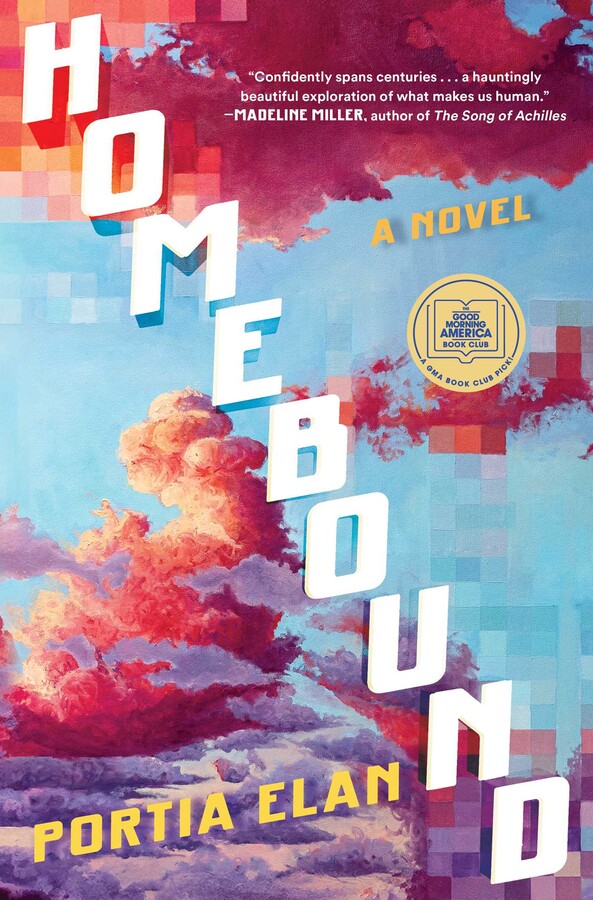
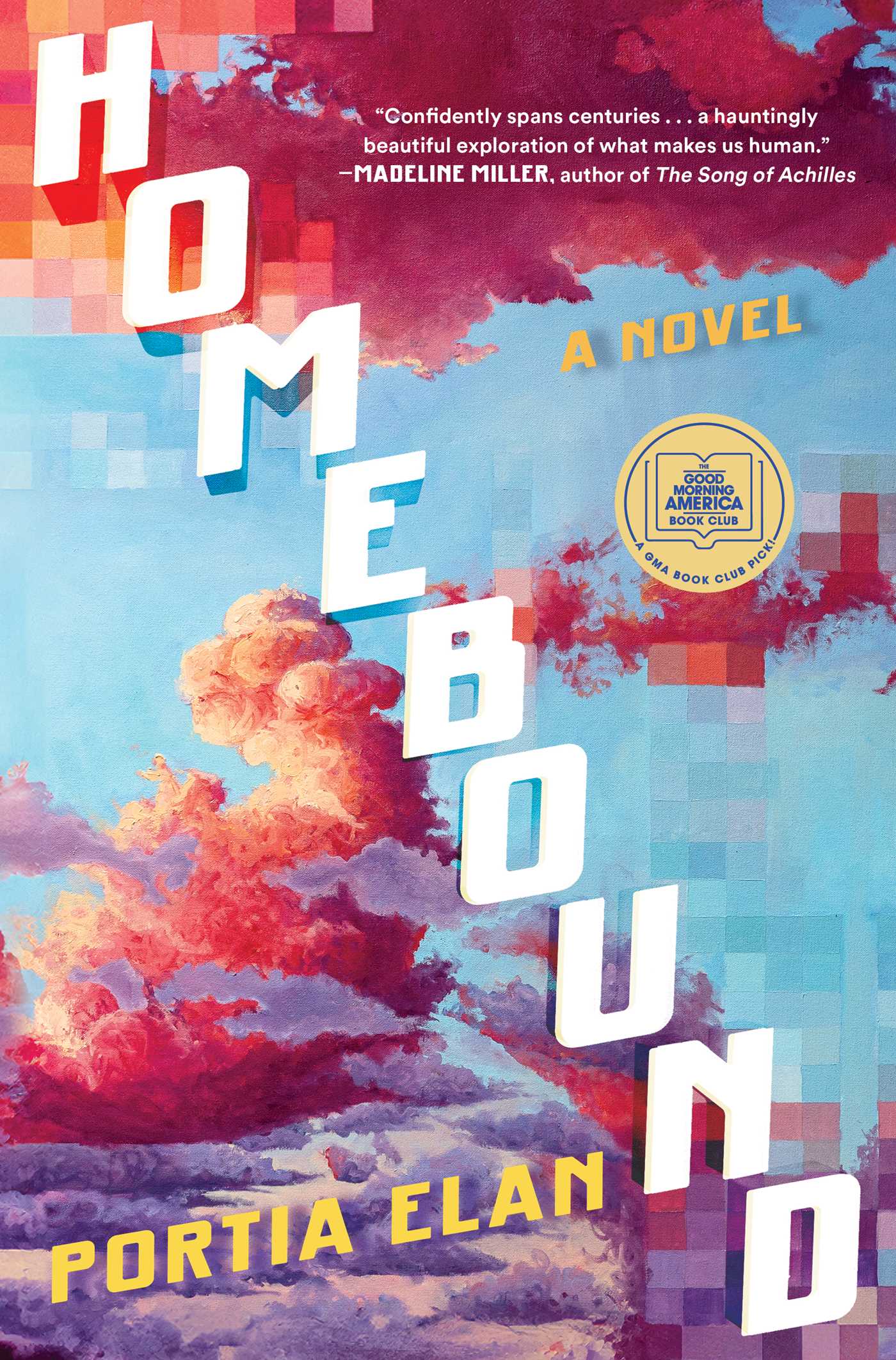
Homebound
A GMA Book Club Pick: A Novel
Table of Contents
About The Book
“A joy...and a hauntingly beautiful exploration of what makes us human. It kept me up all night!” —MADELINE MILLER, #1 New York Times bestselling author of The Song of Achilles
"A big, bold, ecstatic world—full of heart and wonder.” —RUTH OZEKI, New York Times bestselling author of A Tale for the Time Being
1983. Becks is nineteen, blasting her Walkman, and hiding from the fact that her beloved uncle, and the only person who understood her, is dead. Luckily, he left her a half-finished video game to complete—one last collaboration to find her way out of loneliness.
2078. Dr. Portman works at the intersection of artificial intelligence and robotics, wrestling with her responsibility to Earth's precarious future. But increasingly, it seems an exceptional project may transcend everything she believed to be possible...
2586. After decades of life on the sea, Yesiko knows a scavenger's work is rife with moral compromise. Yet when a long-lost piece of technology walks aboard her ship, she is set on a path toward a sacrifice even she may be unwilling to make.
Linking these women across the centuries is a chain reaction of love, longing, and creativity that reveals our deep interconnectedness. Clear-eyed and hopeful, Homebound imagines how future generations will find meaning in the things we leave behind.
Excerpt
CHAPTER 1
1983, SPRING
CINCINNATI
I love the way a computer program doesn’t just describe something: it is the thing.
Words between people—normal language—is like a glaze over the realness of action and being. A bubble, not something you can touch or count on. But code is the doing, is the thing: words and syntax and rules creating their own world, their own existence. Everything the code needs is there, inside the computer.
I tap this semester’s passkey into the door on Baldwin Lab. I get access to the lab because I’m taking freshman Computer Syntax 101, although it’s a bullshit class; I could do most of the assignments in my sleep. This is where I come, though, when I don’t want to go home and face Sheila the Mother, or when Veronica is busy with Jack.
Down the hallway, there’s a grody water cooler, and then the lab, with its twenty Apple IIs and ten terminals hooked into the MUD, a broken clock, no windows, and three rules:
1. No food or drink
2. Save it to a floppy because it will get deleted
3. Don’t touch anyone else’s keyboard
The TA on duty doesn’t care if I work on personal projects, or if I listen to my Walkman with Television or the Clash turned up to eighteen. The glow of the monitor screen washes without judgment over my ripped jeans, my band T-shirts, my dyed-black hair. It feels like freedom.
When I told you, on our weekly call sometime near the start of high school, that I was taking Computer Basics, you got so excited, thinking I was learning BASIC. Back then, I didn’t even know what a programming language was. I sat there, coiling the phone cord around my fingers in Bubbe’s kitchen, which was the only place I called you from, because of Sheila. You described the possibilities of machine learning, and it was like you were speaking to me not from the East Coast, but from somewhere else in time, from some other world.
“You’re going to love it,” you said. “It’s the language of the future.”
I never told you this, although I think you would have laughed: the next day, I stopped by the high school library to see if they had any books on BASIC. I wanted to close the gap between what you’d thought I was learning and the rudimentary typing lessons I was getting in class. The librarian gave me some issues of Creative Computing: I tried to memorize the most obvious commands—LET, PRINT, GOTO, IF—even as my mind tumbled through all the ones I didn’t understand yet: DIM, CHR$, TIME versus TIME$. That same day after school, on a TRS-80 at the RadioShack downtown, I tried typing Valley Bomber, one of the programs printed on thin newsprint in the magazine’s back pages. Command after command after command. It seems so improbable, so strange—that shapes rendered in ink-on-paper could become something else inside the computer, but they can. In the game, the player flew through a valley surrounded by mountains, dropping bombs in the narrow stretch between the heights. I thought, while I was typing it all in, that I wouldn’t mind destroying some mountains. Just destroy it all, maybe.
The game didn’t work. I arrowed up through the lines of code, searching for what I’d done wrong, but the glowing letters swarmed opaquely, refusing to show me. After a week of typing the same sequence in over and over, I found the problem—I’d messed up something simple in the syntax.
But I’d gotten a taste of something. I went back to RadioShack again and again to the code, tossing my backpack under the counter and avoiding eye contact with the salesmen so they wouldn’t bother me. Once the screen booted up, I could be invisible for a while. Not a loner, not a disappointment of a daughter.
Later that year, I would meet Veronica and she would make me less of a loner, even if I stayed a disappointment to Sheila. But when she and I weren’t together, all I wanted to do was slip inside the programs like they were castles, made of logic rather than stones. With a Replacements tape blaring in my headphones, I taught myself to code from a copy of 100 BASIC Computer Games. That’s the book the librarian found for me after I’d burned through all her issues of Creative Computing.
And then, when you thought I was ready, you sent me a letter with the first part of a program, handwritten on a sheet of yellow legal paper. I understood the first few commands—naming the program, a REM line saying [This program will put the wind in your sails], but after that I got lost. What were the commands drawing on the screen? Impossible to tell from just the coordinates. I’d have to see them. The unfinished lines of code beckoned, an invitation to a new world where I was smart, I was important. You programmed real games in Cambridge, but you made time to write code with me. That first program: when we finished it, it drew a sailboat that disappeared into the horizon as the sun set.
Here is one of the things you taught me: every program is like a conversation in which the programmer asks one question over and over again, “How do I make the code do X?” and the code answers, offers a cascade of answers. The result is a personal, intimate kind of logic, and although the code itself might look dry and alien, the choices embedded in it—the defining of variables, sequencing of commands, layering of functions—are like a map of the programmer’s mind.
But you didn’t just teach me to make games, you taught me to love them, too. We worked through the rooms of Zork, each of us making our own grid paper map to mark the grues. We assembled ships in Pirate Adventure. We debated whether The Prisoner was a good game or just a good thought experiment.
And now, almost exactly four years after I started that dumb freshman computer class, I know more than enough BASIC to write a program to calculate the number of days since you died: thirty-seven.
The code I write doesn’t have feelings and it doesn’t care about mine. It either works or it doesn’t. When typing it into the Apple II, I have to stay focused. The fact that you are dead, that you are not in the world anymore, is like a strong magnet held against a cassette. Data—feeling—flattened into irretrievable nothing. But in the code, there are rules and patterns I can rest against. I know where I’ve been and where I’m going.
By the time I’m done today, it’s almost time for the lab to close. I hit RUN.
The TA on duty comes over. I slide my headphones off.
“Bug in the code?” he asks.
The expression came from a literal bug in a computer—that’s the story you told me—a moth trapped in the electrical relays, pulled out by Grace Hopper and taped into a logbook with the annotation “First actual case of bug being found.” A moth, pinioned in the relays, yielding only an error; whatever was intelligible, lost.
Here and now, it would mean: I typed something in wrong, transposed characters or inverted syntax, or even missed a command entirely.
I shrug. “Yeah.” I hit delete and the program’s text evaporates from the screen. “I’ll try again later.”
I get up and go out into the blazing spring evening to take the bus home. I’m thinking about patience, and how, in order to have patience you have to have hope or faith, or some clear idea that it gets better. I’m thinking about all the games you’ll never write, about the body of a moth pressed between relays, about lines of code that yield only “error,” so you have to rewrite it, every line. You can’t do that to a person: scroll through the logic and commands that make them who they are, rewrite the bugs. We run through life once, and when it’s over—when you hit an error—it’s just over, no one waiting to help you fix the mistakes.
Reading Group Guide
Reader Group Guide
The novel begins with an epigraph by Rabbi Abraham Joshua Heschel on loneliness. Did this quote impact your experience of the themes of the novel? How does it hint at what’s in store for the reader?
When we first meet Becks, she says, “Here is one of the things you taught me: every program is like a conversation in which the programmer asks one question over and over again, ‘How do I make the code do X?’ and the code answers, offers a cascade of answers . . .” What are some of the early questions raised in this novel? Are they answered by the end? Who is Becks addressing throughout the novel, and why is that person so important to her?
Who are Yesiko and Root? What do they do to make their living, and what do we know about their world and their ship, Babylon? What does Elan suggest about the future world of 2586 through her portrayal of the day-to-day life of these two characters, the towns and ports they visit, and the debt Yesiko owes to the mysterious Chante?
Describe the first interaction between Yesiko and Chaya. Why does Yesiko distrust the AmAye and their companions Shula and Tov?
Discuss the relationship between Becks and Veronica. Is this a reciprocal relationship? Have you ever felt like you were in Becks’s or Veronica’s situation? How did you navigate it?
In chapter 11 we’re introduced to storying. Root says, “We are our stories. . . . We show respect to the stories, and they keep us.” How does Yesiko react when Chaya tells their story about starships? Why do you think Tov, Shula, and Chaya wholeheartedly believe this tale?
Who is Dr. Tamar Portman? How does Dr. Portman get involved with Jeffrey Bowker and Bowker Industries? What is Jeffrey’s grand plan? Do Bowker’s ambitions remind you of any real-world figures or systems? Why or why not?
Discuss the sections told through Chaya’s POV. What do we learn about Dr. Tamar Portman, the AmAyes, their intended purpose, and Chaya’s “pivot event”? How does Chaya’s evolution over time shape our understanding of the connection between humans and machines in their early years with Dr. Portman?
When Yesiko and Root teach Tov and Shula how to sail, what challenges arise? How does Yesiko’s idea of “crew” change in the latter half of the novel? In your opinion, what accounts for the change?
In part two, we’re immersed in the Homebound game universe. What is this world like, and what is Lieutenant Solo’s mission? Who do you think is playing this game and what might they be searching for? Does this game remind you of similar text-based games in your life?
On the superyacht, what deal does Chante force upon Yesiko? Why does Yesiko go along with it? When she later goes back on the deal, what does this suggest about her feelings toward AmAyes, and Chaya, specifically?
In chapter 30, what do we learn about Chaya’s past and the dome-city? Who is Yusuf and how is this person later connected with Shula and Tov in 2586?
Root repeats in chapter 40 that “We keep the stories, and the stories keep us.” Why is this idea so important to him? What does this mean to you? In your own life, what inspires you to share a story with a friend?
What actions does Root take to secure the safety of Babylon’s crew? Do you believe his choices were necessary? Why or why not?
Becks heads to Indianapolis for a punk show in chapter 42. There she’s called “family” by the bouncer and several of the other concertgoers. What does this feeling of community inspire Becks to do later? How does this event improve her understanding of herself and her uncle?
Elan weaves the narrative through three distinctive time periods: 1983, the far future of 2078, and the far-far future of 2586, when Earth as we know it is a distant memory. “Home” is a core theme in each timeline. In what ways does each character’s definition of the word differ?
What does the Homebound video game mean to each of our main characters who interact with it across the centuries? How does it connect to their personal quests? What was your own relationship to the in-book game? What feelings did it inspire in you?
Queer identity and coming out are central to the storyline of Becks and her uncle. What does Becks learn about herself and others through the events of the novel, and how might those realizations be reflected in the video game?
In what ways does the novel raise questions about the balance between innovative fields like artificial intelligence, space travel, and, on the other hand, human friendships and the environmental conservation on our home planet?
Enhance Your Book Club
1. Play Homebound the game! Visit: https://portiaelan.com/play/.
2. Create your own zine! These small indie magazines or pamphlets can be your own adventure, short stories, collection of poems, or so much more. Visit the Library of Congress page: https://guides.loc.gov/zines/external-websites for more information.
3. As a group, read and discuss another expansive, era-spanning novel that blends genres like The Ministry of Time or Cloud Cuckoo Land. What makes these stories special?
About The Author

Portia Elan studied history at Stanford University and earned an MFA from the University of Victoria, British Columbia, before returning to California, where she has worked as a teacher and public librarian. A former Lambda Literary Fellow, she lives in the San Francisco Bay Area with her wife and an abundance of cats. Homebound is her first novel.
Product Details
- Publisher: Scribner (May 5, 2026)
- Length: 304 pages
- ISBN13: 9781668201732
Raves and Reviews
"An imaginative début... At once a work of dystopian science fiction and a tale of lesbian self-discovery, the novel is ultimately concerned with 'what it means to show up even when you’re afraid.'"—The New Yorker
"You’ll be captivated by this debut novel about a 1980s digital game that connects a queer teen named Becks with characters far in the future."—Los Angeles Times
"Homebound has a puzzle-box thrill – the click of pieces locking into place... The quiet promise of Elan's novel is that your people are out there... It’s the sort of book that might have kept my younger self company. I’m glad this generation will have it."—The Guardian
"An intriguing puzzle box of a novel... By taking a long view of history in her novel, one that telescopes forward and back in time, Elan remains
hopeful about how humanity might make use of the technologies at hand."—The San Francisco Chronicle
"A hugely impressive debut that immediately establishes Elan as a vital new voice."—The Irish Times
"In Portia Elan’s capable hands, Homebound brings its readers to the future through different perspectives, stories, forms, to grapple with the meaning of love and interconnectedness."—Town & Country
"Homebound approaches the scale of the characters’ work with optimism, rather than impatience or despair, and rewards the reader with small glimpses of how that work reverberates across generations. In a moment when I often find myself reading for escape—reading, in essence, to leave this reality for a little while—Homebound made me want to stay, too."—Brooklyn Rail
"Elan writes through the eyes of multiple characters across time and space to explore connection, identity, found family and what a future on this planet might hold for us.”—Southern California News Group
"This striking novel follows Becks, a 19-year-old grappling with a sudden loss and an undying desire to leave Cincinnati, when she takes on a gaming project that has an impact for centuries to come."—People
"Magnificent... A marvel."—Publishers Weekly (starred review)
"Elan deftly knots these threads together, gradually revealing layered stories about queer love and loss, making peace with one’s mistakes, and finding a path through obstacles outside your control... Like Emily St. John Mandel’s Station Eleven, Homebound portrays a plausible, forlorn version of the future, one that’s tied to the past through the staying power of stories."—Booklist (starred review)
“An ingenious narrative that explores the meaning of love and interconnectedness across time.”
—Kirkus (starred review)
"The magic of Elan’s novel is the fact that as it unfolds, the story of Homebound the game is unfolding too, linking readers of Elan’s book with the fictional readers within it... A gift to readers."
—Library Journal (starred review)
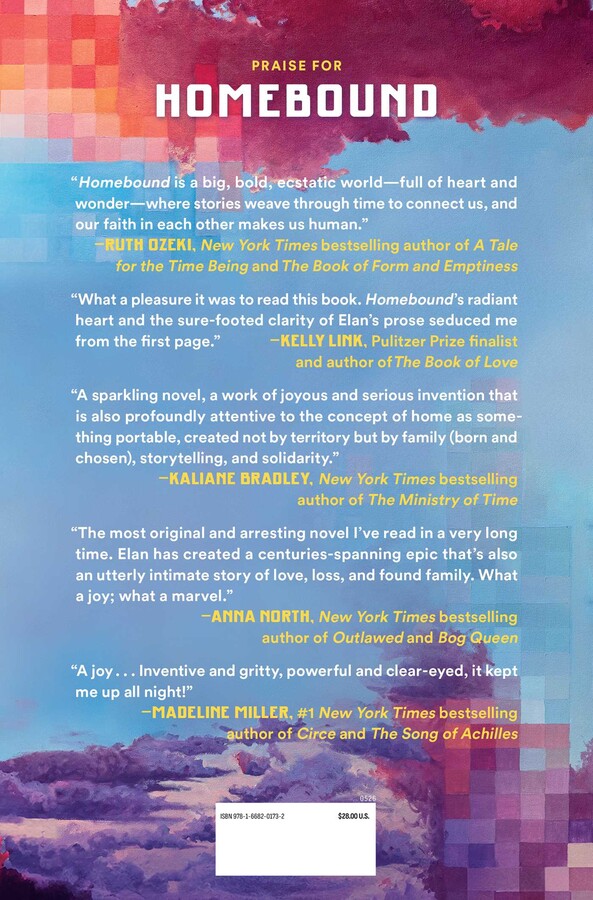
"What a pleasure it was to read this book. Homebound’s radiant heart and the sure-footed clarity of Elan’s prose seduced me from the first page. It's the kind of scope and pleasure that, forgive me for using the shorthand of comparison, reminds me of the novels of Emily St. John Mandel and Daniel Mason."
—KELLY LINK, Pulitzer Prize finalist and author of The Book of Love
“Homebound is a big, bold, ecstatic world—full of heart and wonder—where stories weave through time to connect us, and our faith in each other makes us human.”
—RUTH OZEKI, New York Times bestselling author of A Tale for the Time Being and The Book of Form and Emptiness
"A novel to get lost in, Homebound is deeply felt, deftly crafted and beautifully written. A story of friendship and family, of hope and invention and love. An inspiring debut.”
—CHARLES YU, National Book Award Winner for Interior Chinatown
“A fascinatingly plausible and atmospheric story of a future shaped by tech and love intertwined.”
—EMMA DONOGHUE, #1 bestselling author of The Paris Express
“Homebound is a joy—at once a gripping mystery that confidently spans centuries, and a hauntingly beautiful exploration of what makes us human. Inventive and gritty, powerful and clear-eyed, it kept me up all night!”
—MADELINE MILLER, #1 New York Times bestselling author of Circe and The Song of Achilles
"A sparkling novel, a work of joyous and serious invention that moves fluidly between forms—text-based computer game, coming-of-age story, sea adventure—that is also profoundly attentive to the concept of home as something portable, created by family (born and chosen), storytelling and solidarity."
—KALIANE BRADLEY, New York Times bestselling author of The Ministry of Time
“Homebound's multiple narratives gloriously span centuries into the future to chart the voyages people take to find connection and community. Portia Elan’s ingenious novel is a puzzle-story, a nostalgic ode to 80s video games and punk rock, and a speculative look into the ways technology has reshaped longing. You need to read it!"—KEVIN CHONG, Giller Prize-shortlisted author of The Double Life of Benson Yu
"Inventive and full of feeling. New insight into queerness and computer games unlocked."
—MAGGIE THRASH, author of Rainbow Black
"Homebound is the most original and arresting novel I’ve read in a very long time. Elan has created a century-spanning epic that’s also an utterly intimate story of love, loss, and found family. What a joy; what a marvel."
—ANNA NORTH, New York Times bestselling author of Outlawed and Bog Queen
Resources and Downloads
High Resolution Images
-
Book Cover Image (jpg): Homebound
Hardcover 9781668201732
-
Author Photo (jpg): Portia Elan Photograph © Clayton J. Mitchell(0.1 MB)
Any use of an author photo must include its respective photo credit