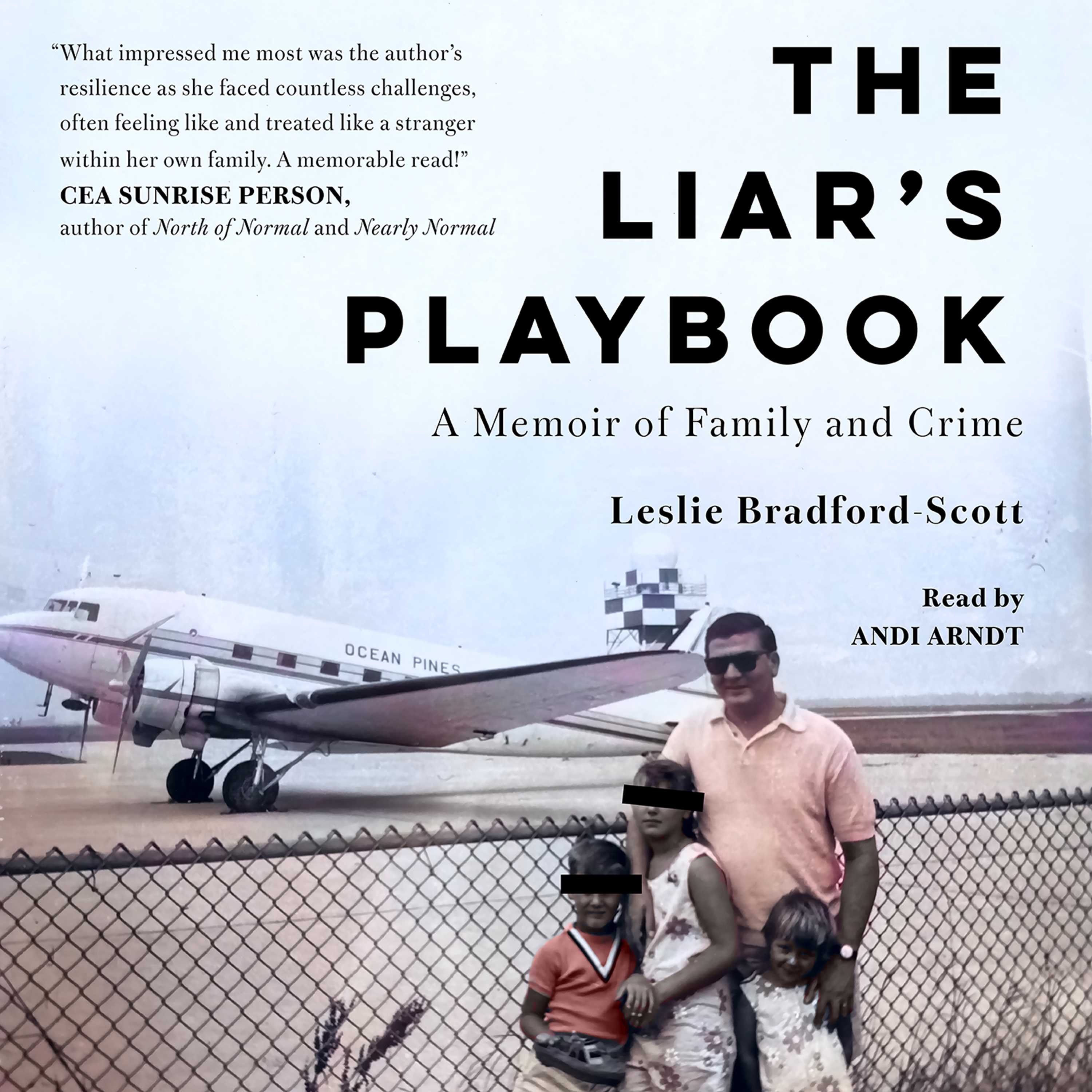
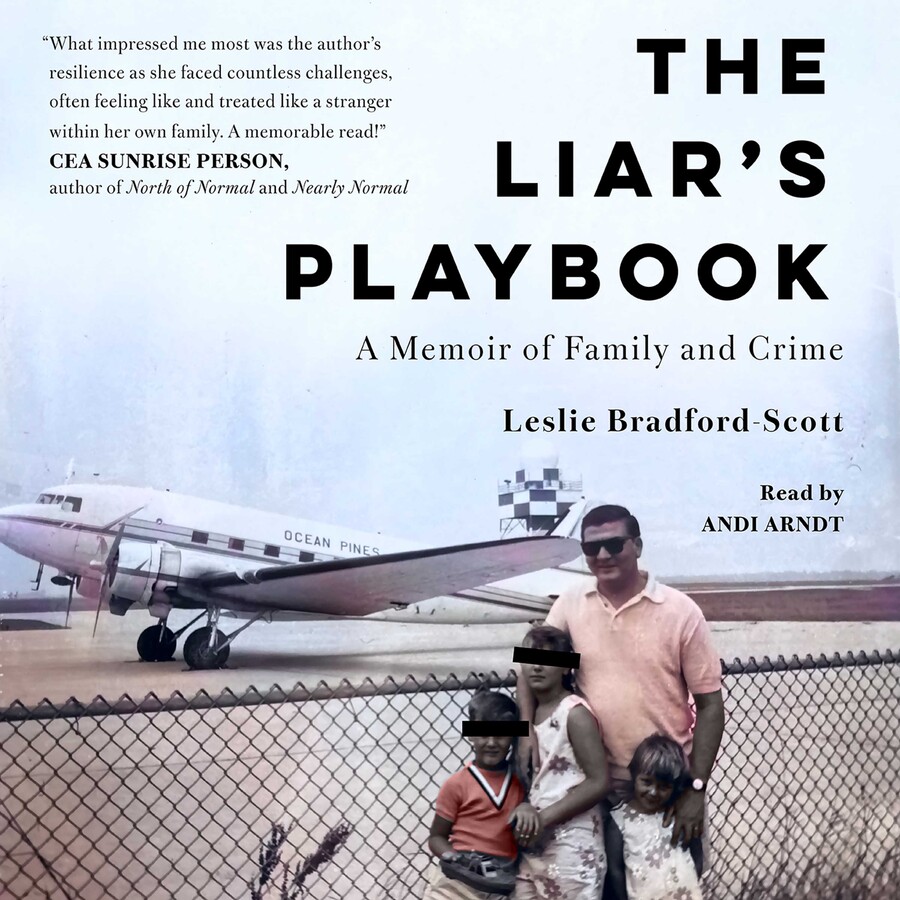
The Liar's Playbook
A Memoir of Family and Crime
LIST PRICE $25.99
Digital products purchased on SimonandSchuster.com must be read on the Simon & Schuster Books app. Learn more.
Buy from Other Retailers
Table of Contents
About The Book
At twelve years old, Leslie Bradford-Scott watched police cars swarm her family’s suburban home in Ontario. Hours later, she, her mom, and her grandmother were fleeing across the border into Florida with no explanation and no questions allowed. In an instant, her idyllic childhood turned into a maelstrom of grift, guns, and tragedy.
Decades later, Leslie’s mother handed her a blue binder—her father’s secret prison manuscript dubbed the Liar’s Playbook. Inside was a confession to trafficking goods, running arms, and playing both sides between international intelligence and the mafia. For most of her life, Leslie believed her father was a drug dealer with delusions of grandeur. Instead, she discovered a shadow world of espionage, organized crime, and explosive family secrets, including her father’s claim that he smuggled jewels to fund CIA-backed operations for the Contras. Her investigation leads to Hamilton’s violent “Bomb City” era, where mobsters like the Musitanos settled scores with dynamite, and some of the blood trails lead straight to her family.
Part true-crime thriller, part intimate memoir, The Liar’s Playbook tracks a daughter’s search for truth through unreliable memories, corrupt intelligence agents, and the long echo of her father’s double life. As she pieces together what really happened, Leslie must ask the one question that still haunts her: Can you forgive someone whose actions nearly destroyed you?
Reading Group Guide
On Truth and Memory
1. Leslie and Jean Claude tell completely different versions of the same events. Whose version did you find yourself believing, and did that shift as you read?
2. Jean Claude wrote 175,000 words in prison. What do you think he was trying to control: the truth, his legacy, or how he would be remembered? Do you think he wanted his manuscript published?
3. Leslie suggests memory is both unreliable and all we have. Did this memoir make you question your own memories of your family?
On Fathers and Daughters
4. Jean Claude told Leslie he had no use for children, yet others describe him as loving and brilliant. How do you reconcile those two versions of the same man?
5. How does growing up with both neglect and real danger shape a person?
6. Before reading his manuscript, what did the line “To Bradley, may you find peace. There is none here.” suggest to you about who he was?
On Family Silence
7. Margot knew the truth for decades and said nothing. Did her silence feel like protection, betrayal, or something more complicated?
8. When Leslie's mother handed over the binder and said “burn it,” what do you think she actually wanted?
9. How much of the family's silence felt cultural, and how much felt specific to the damage Jean Claude caused?
10. When have you told yourself you were keeping a secret to protect someone else and what were you actually protecting?
On Identity and Inheritance
11. Leslie learns that her father's criminal case helped shape Canadian law. What does it mean to inherit a legacy that is both harmful and protective?
12. By the end of the memoir, do you think Leslie is destined to repeat her father's patterns, or has she broken them?
13. Jean Claude built his life on reinvention. Is reinvention survival, erasure, or both?
14. Leslie also rebuilds her life repeatedly. How do you see her strength as both separate from and connected to her father?
On Investigation and Cost
15. Leslie investigates a man who is already dead. What do you think she was really searching for beyond the facts?
16. When told to “just let it go,” why do you think she couldn't?
17. By the end, Leslie understands her father saw her clearly but could never show it. Is that knowledge a gift or another wound?
The Question That Stays With You
18. The epigraph reads: “We are what we pretend to be, so we must be careful about what we pretend to be.”
What do you think Jean Claude was pretending to be, and what did that pretending make him?
About The Author

Leslie Bradford-Scott is an award-winning writer, entrepreneur, and podcaster, and the founder of WaltonWoodFarm.com. She grew up in Grimsby, Ontario, and Florida.
About The Reader

Product Details
- Publisher: Simon & Schuster (May 26, 2026)
- Runtime: 10 hours and 4 minutes
- ISBN13: 9781668174715
Raves and Reviews
“How well do we really know those closest to us, and is the truth better left unknown? The Liar’s Playbook explores one woman's family dynamics when it comes to lies, memories and ethics. But what impressed me most was the author’s resilience as she faced countless challenges, often feeling like and treated like a stranger within her own family. A memorable read!”
— CEA SUNRISE PERSON, author of North of Normal and Nearly Normal
Resources and Downloads
High Resolution Images
-
Book Cover Image (jpg): The Liar's Playbook
Unabridged Audio Download 9781668174715
-
Author Photo (jpg): Leslie Bradford-Scott John Packman(0.1 MB)
Any use of an author photo must include its respective photo credit