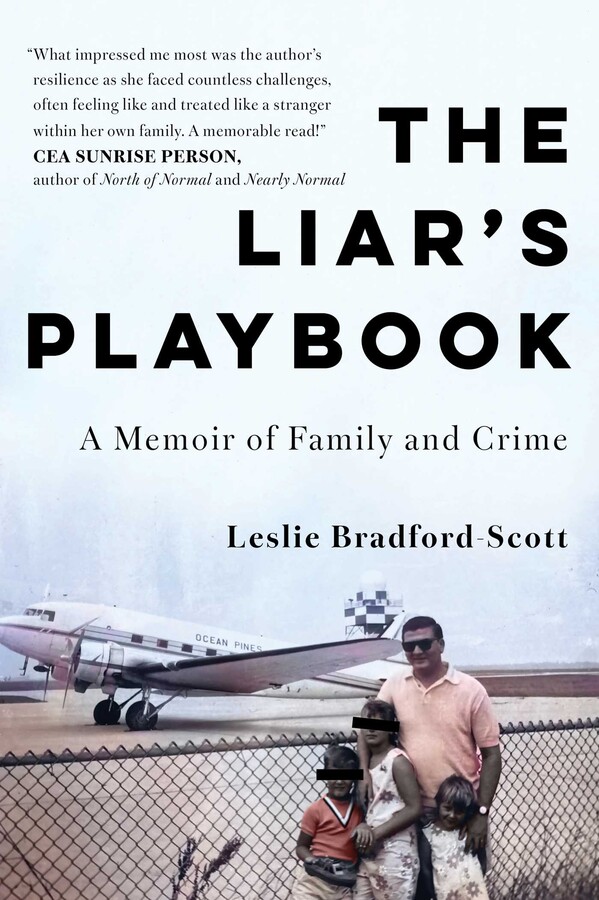
The Liar's Playbook
A Memoir of Family and Crime
Table of Contents
About The Book
The remarkable, true story of an unusual childhood, complete with gangsters, guns, diamonds, drug smuggling, and fraud—just like any other little girl’s life.
At twelve years old, Leslie Bradford-Scott watched police cars swarm her family’s suburban home in Ontario. Hours later, she, her mom, and her grandmother were fleeing across the border into Florida with no explanation and no questions allowed. In an instant, her idyllic childhood turned into a maelstrom of grift, guns, and tragedy.
Decades later, Leslie’s mother handed her a blue binder—her father’s secret prison manuscript dubbed the Liar’s Playbook. Inside was a confession to trafficking goods, running arms, and playing both sides between international intelligence and the mafia. For most of her life, Leslie believed her father was a drug dealer with delusions of grandeur. Instead, she discovered a shadow world of espionage, organized crime, and explosive family secrets, including her father’s claim that he smuggled jewels to fund CIA-backed operations for the Contras. Her investigation leads to Hamilton’s violent “Bomb City” era, where mobsters like the Musitanos settled scores with dynamite, and some of the blood trails lead straight to her family.
Part true-crime thriller, part intimate memoir, The Liar’s Playbook tracks a daughter’s search for truth through unreliable memories, corrupt intelligence agents, and the long echo of her father’s double life. As she pieces together what really happened, Leslie must ask the one question that still haunts her: Can you forgive someone whose actions nearly destroyed you?
Excerpt
THE BLUE BINDER HIT my sunroom table like a bomb with a thirty-year time delay. Inside were 175,000 words that would shatter everything I thought I knew about my father and me. My mother stood there, arms crossed, lips tight, as if bracing for impact.
She didn’t make the long drive from London, Ontario, to Bailieboro lightly these days. Usually, her trunk was crammed with boxes full of basement crap I didn’t want. But this time, she had only a small cooler and the binder. My gaze dropped to its spine. Behind the scratched plastic protector was a name I hadn’t seen in years: Jean Claude Garofoli. My father.
“It’s garbage,” Mom said sharply. “If you don’t want it, burn it.”
The air in the room shifted—suddenly colder. What could be in those pages that my mother wanted reduced to ash?
Before I could respond, she pivoted toward the kitchen, her voice switching to something too casual. “What do you have to drink?”
I picked up the binder. It was heavier than I’d expected. Clutching it to my chest, I followed her into the kitchen, my footsteps hesitant on the cool tiles. “What is it?” I asked. “Where did it come from?”
She kept her back to me, a wall of floral-print cotton. “The basement,” she snapped. “It’s been rotting there for thirty years.” With a flick of her wrist, she waved away the decades like a speck of dust. “At least I’m rid of it now. Do you have any Perrier?”
I froze, the binder leaden in my hands, as she yanked open the fridge. Glass bottles clinked as she rooted around.
“Mom, did you hear me? What is it?”
She paused, her hand lingering on the fridge door. For a moment, I thought she wouldn’t answer. Then, without looking at me, she said flatly, “Your father’s prison manuscript.”
Her words were a sucker punch—which was fitting because, in our family, I was the sucker.
Mom twisted the cap off her sparkling water with an aggressive crack. “It’s probably full of lies,” she muttered, shaking her head. “I couldn’t bear to read it.”
I stood rooted, the weight of the binder dragging at my arms. Thirty years of carefully constructed healing threatened to unravel in an instant. The past I thought I’d buried was rising fast, unstoppable. My father had died in 2013, but in that moment, it felt like he’d just left the room. His presence thickened the air—oppressive, impossible to ignore. Behind my eyes, a slideshow began to play: police cars in our driveway, Brad’s empty bedroom, my father’s face through prison glass, a cold gun pressed to my warm skin. All the jagged pieces of our family history I’d tried so hard to forget.
What truths or lies waited in those pages? And was I strong enough to face them?
I sat at the kitchen island, holding the binder tightly.
My mother had spent decades sharpening her bitterness into a weapon. She was married to Dad for thirty-five years and griped about him for another twenty-plus after the divorce. At eighty-one, she had allowed her mistrust to harden into a fortress of thorns. Any mention of a man—a colleague, a neighbor—would stiffen her spine and turn her voice cold.
“Men,” she’d proclaim, her voice sharp with conviction, “are the architects of all our wars.”
Her wars were far more personal.
She devoured crime dramas, her lips curling in satisfaction whenever justice struck down a cheating man. If a fictional husband found himself in handcuffs—or with a knife lodged in his throat by a scorned wife—she’d smile as if the universe had finally been set right.
I opened the binder. A musty scent wafted up, heavy with the dust of forgotten things. The first page was blank except for a dedication:
To Bradley,
May you find peace. There is none here.
Love, Dad
Brad. My dear, sweet brother, my protector, my confidant, my partner in crime. Brad, a pebble of a name that rippled through every part of who I’d become.
A memory flashed: Brad and I picking the lock on our grandmother’s safe, stealing silver dollars to buy Kit Kats and Oh Henry! bars at Turner’s Corner Store. His mischievous smile, once bright as sunshine, had now faded forever.
My throat tightened, and tears rose before I could stop them. I grabbed the Kleenex box, which was decorated with kittens whose painted-on joy felt mocking. I yanked out tissues one after the other, until the box was empty and the last one drifted to the floor.
I looked at the binder again. It seemed heavier now.
I stumbled into the mudroom, my vision blurred by tears. Yanking open the drawer in our floor-to-ceiling built-ins, the one stuffed with hats and mitts, I shoved the binder deep beneath layers of scarves and fleece. The sound ricocheted off the yellow walls as I slammed the drawer shut. Leaning against the door frame, I let out a shaky breath. The knot in my neck began to loosen, but my mind buzzed.
“Come here, honey,” Mom called softly from the kitchen.
I shuffled back to find her standing at the microwave. She punched in a few seconds and waited as the plate spun inside. The sweet, familiar scent of banana bread filled the air as she removed it, steam now curling from the loaf’s golden crust.
“Here,” she said, putting the warm plate into my hands. “I made it this morning before I left.”
I took a bite, and the flavors exploded on my tongue: sweet banana, warm cinnamon, the crunch of walnuts. It tasted like comfort. Like the mother I’d always longed for.
For a fleeting moment, I saw her clearly—the woman who could soften instead of bristle, who could offer warmth instead of walls. But the moment passed, and the distance between us reassembled, brick by silent brick.
Months went by before I touched the binder again. November’s biting cold sent me to the mudroom for a scarf and mitts one day. When my fingers brushed against the binder’s spine, curiosity flickered to life.
What was I so afraid of?
I carried it to the kitchen, poured myself a cup of steaming mint tea, and curled into a chair by the living room window. The lake outside was still, its calmness grounding me.
There was no turning back. Whatever lay inside was already part of me, waiting to be unearthed. I took a deep breath and opened the binder.
I would dub it “The Liar’s Playbook.”
My dad’s manuscript on my sunroom table The Garofoli family in Venezuela, 1975
Reading Group Guide
On Truth and Memory
1. Leslie and Jean Claude tell completely different versions of the same events. Whose version did you find yourself believing, and did that shift as you read?
2. Jean Claude wrote 175,000 words in prison. What do you think he was trying to control: the truth, his legacy, or how he would be remembered? Do you think he wanted his manuscript published?
3. Leslie suggests memory is both unreliable and all we have. Did this memoir make you question your own memories of your family?
On Fathers and Daughters
4. Jean Claude told Leslie he had no use for children, yet others describe him as loving and brilliant. How do you reconcile those two versions of the same man?
5. How does growing up with both neglect and real danger shape a person?
6. Before reading his manuscript, what did the line “To Bradley, may you find peace. There is none here.” suggest to you about who he was?
On Family Silence
7. Margot knew the truth for decades and said nothing. Did her silence feel like protection, betrayal, or something more complicated?
8. When Leslie's mother handed over the binder and said “burn it,” what do you think she actually wanted?
9. How much of the family's silence felt cultural, and how much felt specific to the damage Jean Claude caused?
10. When have you told yourself you were keeping a secret to protect someone else and what were you actually protecting?
On Identity and Inheritance
11. Leslie learns that her father's criminal case helped shape Canadian law. What does it mean to inherit a legacy that is both harmful and protective?
12. By the end of the memoir, do you think Leslie is destined to repeat her father's patterns, or has she broken them?
13. Jean Claude built his life on reinvention. Is reinvention survival, erasure, or both?
14. Leslie also rebuilds her life repeatedly. How do you see her strength as both separate from and connected to her father?
On Investigation and Cost
15. Leslie investigates a man who is already dead. What do you think she was really searching for beyond the facts?
16. When told to “just let it go,” why do you think she couldn't?
17. By the end, Leslie understands her father saw her clearly but could never show it. Is that knowledge a gift or another wound?
The Question That Stays With You
18. The epigraph reads: “We are what we pretend to be, so we must be careful about what we pretend to be.”
What do you think Jean Claude was pretending to be, and what did that pretending make him?
About The Author

Leslie Bradford-Scott is an award-winning writer, entrepreneur, and podcaster, and the founder of WaltonWoodFarm.com. She grew up in Grimsby, Ontario, and Florida.
Product Details
- Publisher: Simon & Schuster (May 26, 2026)
- Length: 336 pages
- ISBN13: 9781668069394
Raves and Reviews
"A stranger-than-fiction account . . . propulsive and emotionally nuanced."--PUBLISHERS WEEKLY
“How well do we really know those closest to us, and is the truth better left unknown? The Liar’s Playbook explores one woman's family dynamics when it comes to lies, memories and ethics. But what impressed me most was the author’s resilience as she faced countless challenges, often feeling like and treated like a stranger within her own family. A memorable read!”
— CEA SUNRISE PERSON, author of North of Normal and Nearly Normal
“The Liar’s Playbook is an unflinching, honest, and deeply brave memoir. Leslie Bradford-Scott opens the door to a family shaped by secrecy, where love and deception are tightly entwined. With extraordinary clarity and compassion, she explores the cost of inherited lies and the courage it takes to rewrite the stories we were raised to believe.”
— MARISSA STAPLEY, New York Times-bestselling author of Lucky
“Leslie Bradford-Scott’s gutsy, riveting memoir traces her lifelong search for the continuously shifting truth about her father—a charming, reckless, law-breaking man who frequently and casually put her young life at risk. Her investigation uncovers disturbing facts about her family, yet it also exposes an integral part of her inheritance: an astounding capacity for survival and creative re-invention.”
— KATH JONATHAN, author of The Resistance Painter
“This unflinchingly honest debut is a riveting account of a daughter’s struggle to come to terms with her father’s abusive, felonious past, and of the self-awareness that comes with healing. What is so extraordinary about Leslie Bradford-Scott is her unwavering strength, wisdom and courage to follow her dreams and create a fulfilling life for herself and her children, despite a volatile past rife with betrayal, trauma, rejection, secrets and lies. Told with a visceral understanding of the human condition, in compellingly wrought prose, The Liar’s Playbook captures the resilience and loneliness of one woman’s search for truth, identity, love, and a safe place to call home.”
— SHELLY SANDERS, author of The Night Sparrow and Daughters of the Occupation
“This book is beautifully written and I was captivated by the story. The Liar’s Playbook is suspenseful, surprising, heartbreaking, and ultimately, hopeful.”
— LORI THICKE, author of Dreamer’s Daughter
“The Liar’s Playbook is a riveting ride through a wacky childhood to accomplished adulthood, and then a sharp U-turn to separate the truth from the lies. Its generous sprinkling of guns, gems and getaways, and how a little girl fits into it all, makes for a story Tarantino could direct.”
— SUE HINCENBERGS, author of The Retirement Plan
Resources and Downloads
High Resolution Images
-
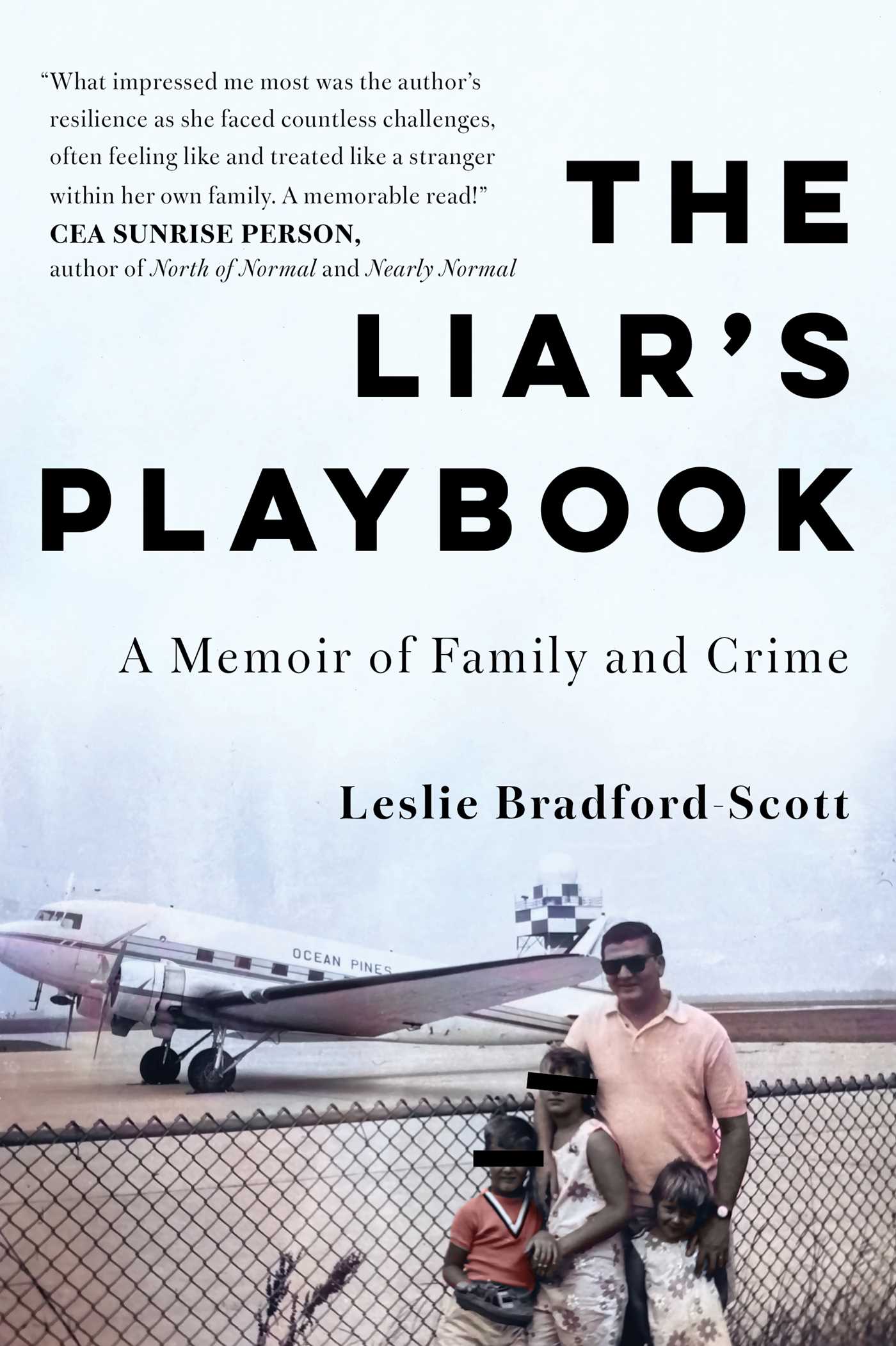
Book Cover Image (jpg): The Liar's Playbook
Trade Paperback 9781668069394
-
Author Photo (jpg): Leslie Bradford-Scott John Packman(0.1 MB)
Any use of an author photo must include its respective photo credit