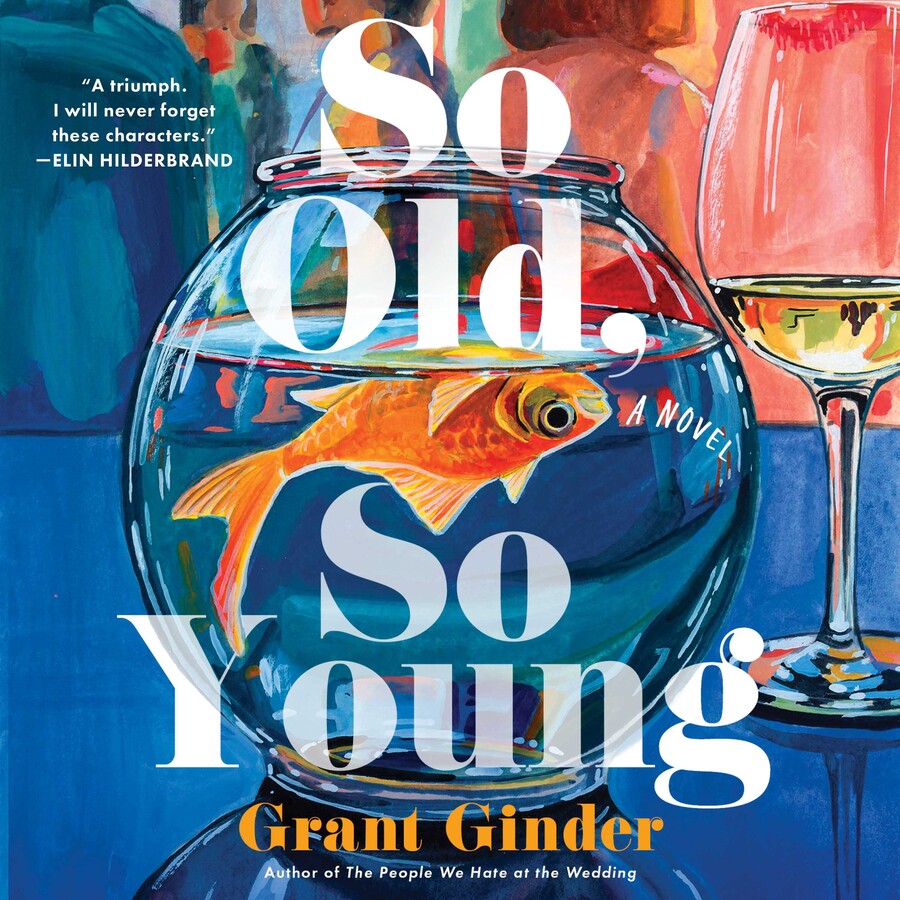
So Old, So Young
A Novel
By Grant Ginder
Read by Jill Paice, Christian Barillas, Santino Fontana, Greta Jung, Patti Murin and Michael Urie
LIST PRICE $26.99
PRICE MAY VARY BY RETAILER
Digital products purchased on SimonandSchuster.com must be read on the Simon & Schuster Books app. Learn more.
Buy from Other Retailers
Table of Contents
About The Book
NATIONAL BESTSELLER
A Most Anticipated Novel of 2026 by Time, Town & Country, Bustle, and Zibby Media • A Best New Book by People, New York Post, Library Journal, and BookBub • February Book Club Pick by Good Housekeeping
“The writing is so good it left me breathless. (Please someone make it into a series!) So Old, So Young is a triumph. I will never forget these characters.” —Elin Hilderbrand
“I gulped it down on a plane, taking breaks to recall my own friend group from college. The people who are your real friends, the novel invites us to remember, often drive you completely crazy.” —The New York Times
Six Friends.
Five Parties.
Twenty Years…
How did we get So Old, So Young?
From Grant Ginder, the bestselling author of The People We Hate at the Wedding, comes a generation-defining novel that is part love story, part tragic comedy. Five parties over the course of twenty years bring six college friends together, exploring the ways we run from and cling to our friends in love, life, and death.
For Marco and Mia, Sasha and Theo, Richie and Adam, the one constant in life after college together has been change. New jobs. New cities. New spouses. New children. Through it all, one thing they thought would always stay the same is their friendship.
But time has a way of breaking even the strongest bonds, and testing what we thought we knew. From East Village apartment parties and disastrous destination weddings, to fortieth birthdays and suburban backyard barbecues, Grant Ginder’s resonant, funny, and deeply moving novel is a story about the growing pains of the Millennial generation, and a celebration of how love can shift, stumble, and grow into something bigger than we ever could have imagined.
A Most Anticipated Novel of 2026 by Time, Town & Country, Bustle, and Zibby Media • A Best New Book by People, New York Post, Library Journal, and BookBub • February Book Club Pick by Good Housekeeping
“The writing is so good it left me breathless. (Please someone make it into a series!) So Old, So Young is a triumph. I will never forget these characters.” —Elin Hilderbrand
“I gulped it down on a plane, taking breaks to recall my own friend group from college. The people who are your real friends, the novel invites us to remember, often drive you completely crazy.” —The New York Times
Six Friends.
Five Parties.
Twenty Years…
How did we get So Old, So Young?
From Grant Ginder, the bestselling author of The People We Hate at the Wedding, comes a generation-defining novel that is part love story, part tragic comedy. Five parties over the course of twenty years bring six college friends together, exploring the ways we run from and cling to our friends in love, life, and death.
For Marco and Mia, Sasha and Theo, Richie and Adam, the one constant in life after college together has been change. New jobs. New cities. New spouses. New children. Through it all, one thing they thought would always stay the same is their friendship.
But time has a way of breaking even the strongest bonds, and testing what we thought we knew. From East Village apartment parties and disastrous destination weddings, to fortieth birthdays and suburban backyard barbecues, Grant Ginder’s resonant, funny, and deeply moving novel is a story about the growing pains of the Millennial generation, and a celebration of how love can shift, stumble, and grow into something bigger than we ever could have imagined.
Reading Group Guide
1. While the point of view rotates between the group of friends, it’s Mia who grounds each of the sections; no matter the party, we always see it first through her eyes. How does she act as a guide for the reader? What unique perspective does she offer that the other characters do not?
2. Each of the five sections are sprinkled with cultural references and allusions that help us to locate them in a specific place and time. For example, on New Years Eve, 2007, Flo Rida plays from an iPod and Mia works for the now-defunct Details magazine; later, in 2019, Nina makes her fortune selling e-cigarettes. Which details made you especially nostalgic? And what details would you add to each of the sections that aren’t already there?
3. As a twenty-two-year-old in search of excitement, Sasha develops a habit of sneaking into parties—or, as she describes it, “looking for places she doesn’t belong” (page 37). While there, she feels her mind “slipping into a liminal space, a sort of psychic DMZ that [exists] between who everyone [expects] her to be and who she [knows] she actually [is]” (page 37). How does this feeling help—and haunt—her later in life? And to what degree do all the characters struggle with reconciling who they are with the expectations that are placed on them?
4. After Adam breaks up with Richie in Cancun, he explains to Mia how he feels like he may have outgrown him. Given how infatuated Adam was with Richie when they first met, this is a startling twist of fate. And yet, many of the other characters experience similar changes of heart toward people in their lives. What exactly does Adam mean by “outgrowing” someone? In your experience, how—and why—has this occurred in your own relationships?
5. In many ways, Richie is the novel’s most flawed character. He struggles with addiction, can be unfathomably cruel, and, at least when he’s younger, takes many of his friendships for granted. At the same time, as the friends get older, he’s often the most clear-eyed about the state of their relationships and goes out of his way to make amends with Nina. How does this complicate your understanding of him as a character? How do you think Richie’s struggles contribute to his perspective on friendship, loyalty, and love?
6. At the end of the third section, we’re given a surprise chapter from Nina Guzman’s point of view. Why do you suppose the author decided to focus on Nina at this moment in time? What are the effects of the chapter on how you understand Nina and her role in the novel?
7. Friendship is obviously a central theme in the novel—both how it can save us, but also how difficult it is to maintain in the face of change. In fact, at the party in Montclair, it’s conflicting ideas about friendship and loyalty that ultimately drive Sasha and Mia apart. How do they talk past each other in this scene? What is the book implying about our own nostalgia can trap us?
8. Were you surprised by who died at the end of the book? Why do you think the author decided this character would die, as opposed to one of the other characters?
9. While there are a number of reconciliations at the end of the book, many of them are nonetheless fragile. It’s unclear, for example, whether Marco and Mia will ultimately get back together, or if their present life circumstances will keep them apart. And while Richie makes the decision not to drink again, his sobriety is painted as tenuous, and still a struggle. Why do you think the author decided to keep things relatively open-ended? What does this imply about friendship, aging, and nostalgia? What do you imagine these characters’ lives looking like in the next five years? The next ten years?
10. The cast of characters in So Old, So Young is decidedly Millennial. As they age, what experiences and struggles do they face that are specific to that generation? Which ones are universal?
11. So Old, So Young has a unique structure: each of its five sections takes place at a specific party or gathering, with large block of time elapsing between them. While the novel covers two decades, we only see brief snapshots of the characters’ lives. Why do you think the author chose this particular structure for the story? How does it allow the reader to gain new insights into the characters’ growth and their relationships?
12. In addition to themes of friendship and aging, the novel explores the ways in which seemingly small decisions or meetings can have lasting, profound consequences. Looking back at your life, which five parties or gatherings do you consider to be the most significant? If you could go back and change one thing from one of them, what would it be, and how do you imagine it affecting the course of your life?
2. Each of the five sections are sprinkled with cultural references and allusions that help us to locate them in a specific place and time. For example, on New Years Eve, 2007, Flo Rida plays from an iPod and Mia works for the now-defunct Details magazine; later, in 2019, Nina makes her fortune selling e-cigarettes. Which details made you especially nostalgic? And what details would you add to each of the sections that aren’t already there?
3. As a twenty-two-year-old in search of excitement, Sasha develops a habit of sneaking into parties—or, as she describes it, “looking for places she doesn’t belong” (page 37). While there, she feels her mind “slipping into a liminal space, a sort of psychic DMZ that [exists] between who everyone [expects] her to be and who she [knows] she actually [is]” (page 37). How does this feeling help—and haunt—her later in life? And to what degree do all the characters struggle with reconciling who they are with the expectations that are placed on them?
4. After Adam breaks up with Richie in Cancun, he explains to Mia how he feels like he may have outgrown him. Given how infatuated Adam was with Richie when they first met, this is a startling twist of fate. And yet, many of the other characters experience similar changes of heart toward people in their lives. What exactly does Adam mean by “outgrowing” someone? In your experience, how—and why—has this occurred in your own relationships?
5. In many ways, Richie is the novel’s most flawed character. He struggles with addiction, can be unfathomably cruel, and, at least when he’s younger, takes many of his friendships for granted. At the same time, as the friends get older, he’s often the most clear-eyed about the state of their relationships and goes out of his way to make amends with Nina. How does this complicate your understanding of him as a character? How do you think Richie’s struggles contribute to his perspective on friendship, loyalty, and love?
6. At the end of the third section, we’re given a surprise chapter from Nina Guzman’s point of view. Why do you suppose the author decided to focus on Nina at this moment in time? What are the effects of the chapter on how you understand Nina and her role in the novel?
7. Friendship is obviously a central theme in the novel—both how it can save us, but also how difficult it is to maintain in the face of change. In fact, at the party in Montclair, it’s conflicting ideas about friendship and loyalty that ultimately drive Sasha and Mia apart. How do they talk past each other in this scene? What is the book implying about our own nostalgia can trap us?
8. Were you surprised by who died at the end of the book? Why do you think the author decided this character would die, as opposed to one of the other characters?
9. While there are a number of reconciliations at the end of the book, many of them are nonetheless fragile. It’s unclear, for example, whether Marco and Mia will ultimately get back together, or if their present life circumstances will keep them apart. And while Richie makes the decision not to drink again, his sobriety is painted as tenuous, and still a struggle. Why do you think the author decided to keep things relatively open-ended? What does this imply about friendship, aging, and nostalgia? What do you imagine these characters’ lives looking like in the next five years? The next ten years?
10. The cast of characters in So Old, So Young is decidedly Millennial. As they age, what experiences and struggles do they face that are specific to that generation? Which ones are universal?
11. So Old, So Young has a unique structure: each of its five sections takes place at a specific party or gathering, with large block of time elapsing between them. While the novel covers two decades, we only see brief snapshots of the characters’ lives. Why do you think the author chose this particular structure for the story? How does it allow the reader to gain new insights into the characters’ growth and their relationships?
12. In addition to themes of friendship and aging, the novel explores the ways in which seemingly small decisions or meetings can have lasting, profound consequences. Looking back at your life, which five parties or gatherings do you consider to be the most significant? If you could go back and change one thing from one of them, what would it be, and how do you imagine it affecting the course of your life?
About The Author

Photograph by Patrick Lupinski
Grant Ginder
Grant Ginder is the author of five novels, including Let’s Not Do That Again and The People We Hate at the Wedding, now a major motion picture starring Allison Janney, Kristen Bell, and Ben Platt. Originally from Southern California, Ginder received his MFA from New York University, where he teaches writing.
About The Readers

Jill Paice
Christian Barillas
Santino Fontana
Greta Jung
Patti Murin
Michael Urie
Product Details
- Publisher: Simon & Schuster Audio (February 17, 2026)
- Runtime: 11 hours and 20 minutes
- ISBN13: 9781797194356
Resources and Downloads
High Resolution Images
-
Book Cover Image (jpg): So Old, So Young
Unabridged Audio Download 9781797194356
-
Author Photo (jpg): Grant Ginder Photograph by Patrick Lupinski(0.1 MB)
Any use of an author photo must include its respective photo credit