
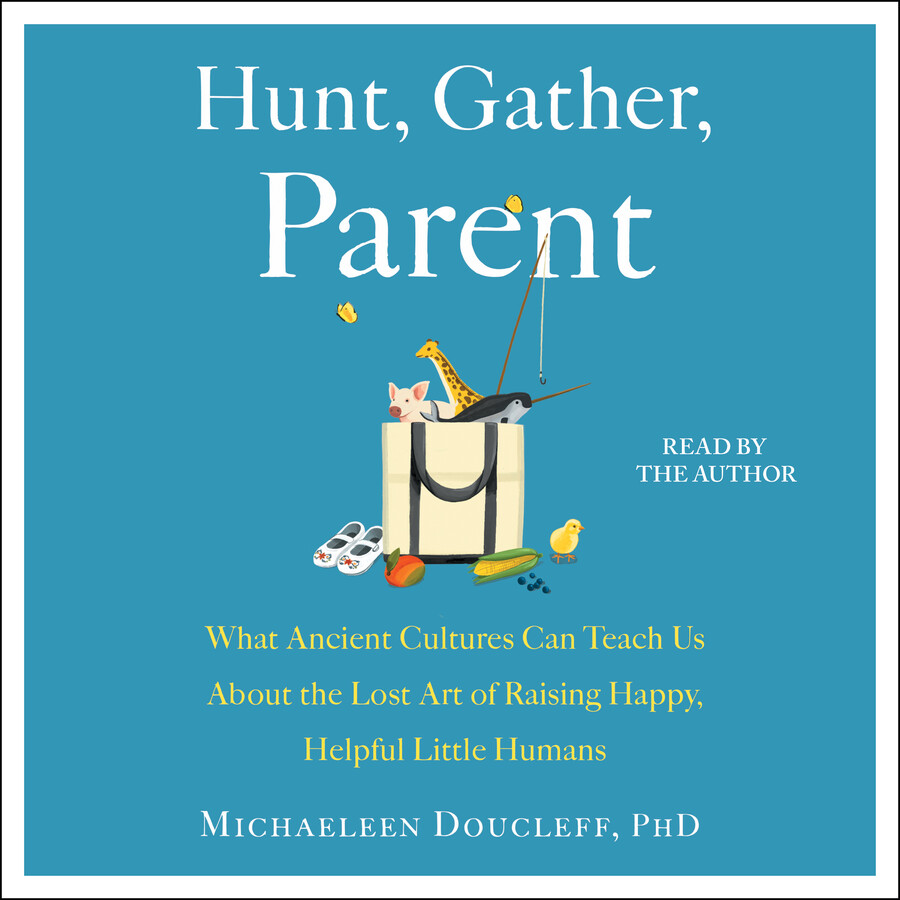
Hunt, Gather, Parent
What Ancient Cultures Can Teach Us About the Lost Art of Raising Happy, Helpful Little Humans
LIST PRICE $26.99
Digital products purchased on SimonandSchuster.com must be read on the Simon & Schuster Books app. Learn more.
Buy from Other Retailers
Table of Contents
About The Book
The oldest cultures in the world have mastered the art of raising happy, well-adjusted children. What can we learn from them?
“Hunt, Gather, Parent is full of smart ideas that I immediately wanted to force on my own kids.” —Pamela Druckerman, The New York Times Book Review
When Dr. Michaeleen Doucleff becomes a mother, she examines the studies behind modern parenting guidance and finds the evidence frustratingly limited and often ineffective. Curious to learn about more effective parenting approaches, she visits a Maya village in the Yucatán Peninsula. There she encounters moms and dads who parent in a totally different way than we do—and raise extraordinarily kind, generous, and helpful children without yelling, nagging, or issuing timeouts. What else, Doucleff wonders, are Western parents missing out on?
In Hunt, Gather, Parent, Doucleff sets out with her three-year-old daughter in tow to learn and practice parenting strategies from families in three of the world’s most venerable communities: Maya families in Mexico, Inuit families above the Arctic Circle, and Hadzabe families in Tanzania. She sees that these cultures don’t have the same problems with children that Western parents do. Most strikingly, parents build a relationship with young children that is vastly different from the one many Western parents develop—it’s built on cooperation instead of control, trust instead of fear, and personalized needs instead of standardized development milestones.
Maya parents are masters at raising cooperative children. Without resorting to bribes, threats, or chore charts, Maya parents rear loyal helpers by including kids in household tasks from the time they can walk. Inuit parents have developed a remarkably effective approach for teaching children emotional intelligence. When kids cry, hit, or act out, Inuit parents respond with a calm, gentle demeanor that teaches children how to settle themselves down and think before acting. Hadzabe parents are experts on raising confident, self-driven kids with a simple tool that protects children from stress and anxiety, so common now among American kids.
Not only does Doucleff live with families and observe their methods firsthand, she also applies them with her own daughter, with striking results. She learns to discipline without yelling. She talks to psychologists, neuroscientists, anthropologists, and sociologists and explains how these strategies can impact children’s mental health and development. Filled with practical takeaways that parents can implement immediately, Hunt, Gather, Parent helps us rethink the ways we relate to our children, and reveals a universal parenting paradigm adapted for American families.
Reading Group Guide
In the years since its publication, Michaeleen Doucleff’s Hunt, Gather, Parent: What Ancient Cultures Can Teach Us About the Lost Art of Raising Happy, Helpful Little Humans, the revolutionary book has transformed parenting in Western culture and has become only more relevant. In its pages, Doucleff shares the ups and downs (especially the downs) of her own parenting experience and brings readers along on an exciting journey to learn from three cultures that mastered the art of parenting long ago. Along with her daughter, Rosy, Doucleff visits Maya, Inuit, and Hadzabe villages and, blending her observations with research, shows how these cultures offer cures to the most common parenting ailments. Hunt, Gather, Parent includes tips and practices for you to apply to your own parenting and is at once wise, heartfelt, entertaining, and groundbreaking.
Discussion Questions
1. Why do you think the author chose to open with her own vulnerable account of parenting struggles? Did this change how you received the rest of the book?
2. Why do you think Western psychology has so heavily ignored Eastern cultures?
3. Early in the book, the author says that the major problem in parenting today is that we are “looking at the parenting landscape through a tiny keyhole,” of the Western perspective, which makes kids “more anxious and also less prepared for the unpredictable” (pages 6–7). Does this explain some of what you have observed in modern parenting and why you felt the need to read such a book in the first place?
4. How might a chore chart inhibit a child from learning the Maya concept of acomedido?
5. What are the three steps to teaching anything? (See chapter 4, on Maya parenting.).
6. Why do you think Western parents often underestimate how capable a young child can be at helping the family?
7. Look at the graphic on page 149. Can you think of specific moments when you have inadvertently modeled anger for your child? What aout moments when your own parents modeled anger for you?
8. The author encourages adults to develop a habit of calmly walking away when angry with their children. How is this different from suppressing anger?
9. In what ways does “the look,” popularly used in Inuit cultures, communicate more clearly to children than frustrated words?
10. What is the gift economy, and how does it relate to the Hadzabe approach to parenting?
11. What is the difference between independence and autonomy, as observed in Hadzabe parenting? How would you describe the differences between Hadzabe and Western parents?
12. How does Benjamin Reiss’s discovery about sleep in Western culture pertain to your own parenting habits (and how you might refine them)?
13. How does minimal interference reduce conflict? And in what small ways can you begin practicing it with your children?
14. After reading Hunt, Gather, Parent, do you feel more empowered as a parent? Do you believe the author successfully helped give the power back to the parents (and out of the hands of male doctors and other outdated sources of parenting advice, for example)?
15. Was there a particular section of the book—focused on one specific culture’s parenting—that you found most surprising? Why? What does this say about your own parenting? Discuss as a group.
16. The author claims that Western cultures struggling so much with parenting because they “go against the natural instincts of children” (page 25). After reading the book, can you name examples of going against these instincts in the author’s parenting of Rosie? What about your own parenting?
Activities:
1. Try keeping a weekly or otherwise periodic TEAM chart to fill out with examples of when you practiced each of the four concepts in your own parenting. Reflect on this practice and experience as a group and discuss what may have changed over time.
2. Have everyone in your book club spend a short amount of time researching parenting in another culture (not your own and not the three observed in this book). Come back together and share three to four interesting and useful facts you learned that you can try applying to your own parenting.
3. Write a letter addressed to each one of your children. Express your challenges and struggles together, as well as your hopes and dreams for their development. Put a date on it and place it somewhere you will remember. In six months, then again in a year, return to the letter(s). Do you observe any changes in yourself or in your interactions? Were any challenges minimized, even a little bit, or did any goals inch closer to fulfillment? Discuss.
About The Author

Michaeleen Doucleff, PhD, has reported on children’s health for NPR’s science desk for more than a decade. In 2015, she was part of the team that earned a George Foster Peabody Award for its coverage of the Ebola outbreak in West Africa. She has a doctorate in chemistry from the University of California, Berkeley, and a bachelor of science from the California Institute of Technology. Before joining NPR, Doucleff completed a postdoctoral fellowship at the National Institutes of Health. She lives with her husband and daughter in Alpine, Texas, and is the author of the New York Times bestseller Hunt, Gather, Parent and Dopamine Kids.
About The Reader
Michaeleen Doucleff, PhD, has reported on children’s health for NPR’s science desk for more than a decade. In 2015, she was part of the team that earned a George Foster Peabody Award for its coverage of the Ebola outbreak in West Africa. She has a doctorate in chemistry from the University of California, Berkeley, and a bachelor of science from the California Institute of Technology. Before joining NPR, Doucleff completed a postdoctoral fellowship at the National Institutes of Health. She lives with her husband and daughter in Alpine, Texas, and is the author of the New York Times bestseller Hunt, Gather, Parent and Dopamine Kids.
Product Details
- Publisher: Simon & Schuster Audio (March 2, 2021)
- Runtime: 11 hours and 11 minutes
- ISBN13: 9781797118291
Raves and Reviews
"NPR reporter Michaeleen Doucleff narrates this audiobook—part memoir and part guide on contemporary parenting. She is honest, clear, and thoughtful as she presents a wide range of research on parenting theories from many cultures. For those seeking new ways to connect with or better understand their children, this will be a welcome listen. Doucleff creates the feeling she is in your kitchen, swapping stories and wisdom of the ages. This title is easy on the ears, and the chapters go by swiftly. For an author turned narrator, she is very confident as she presents ideas from diverse sources. From the Inuit to city dwellers, Doucleff informs as she entertains, regaling us with advice of how to keep the peace."
– AudioFile Magazine
Resources and Downloads
High Resolution Images
-
Book Cover Image (jpg): Hunt, Gather, Parent
Unabridged Audio Download 9781797118291

-
Author Photo (jpg): Michaeleen Doucleff Photograph by Simone Anne(0.1 MB)
Any use of an author photo must include its respective photo credit
