
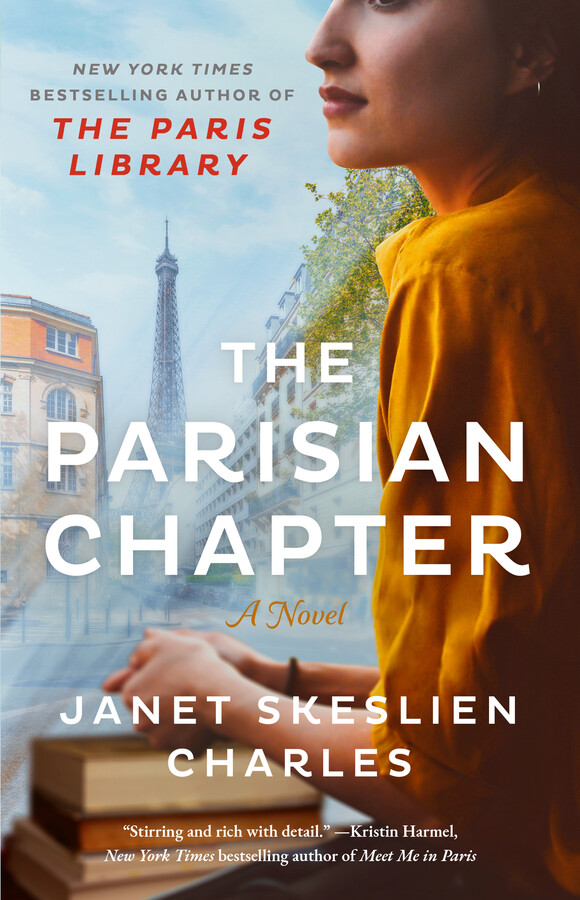

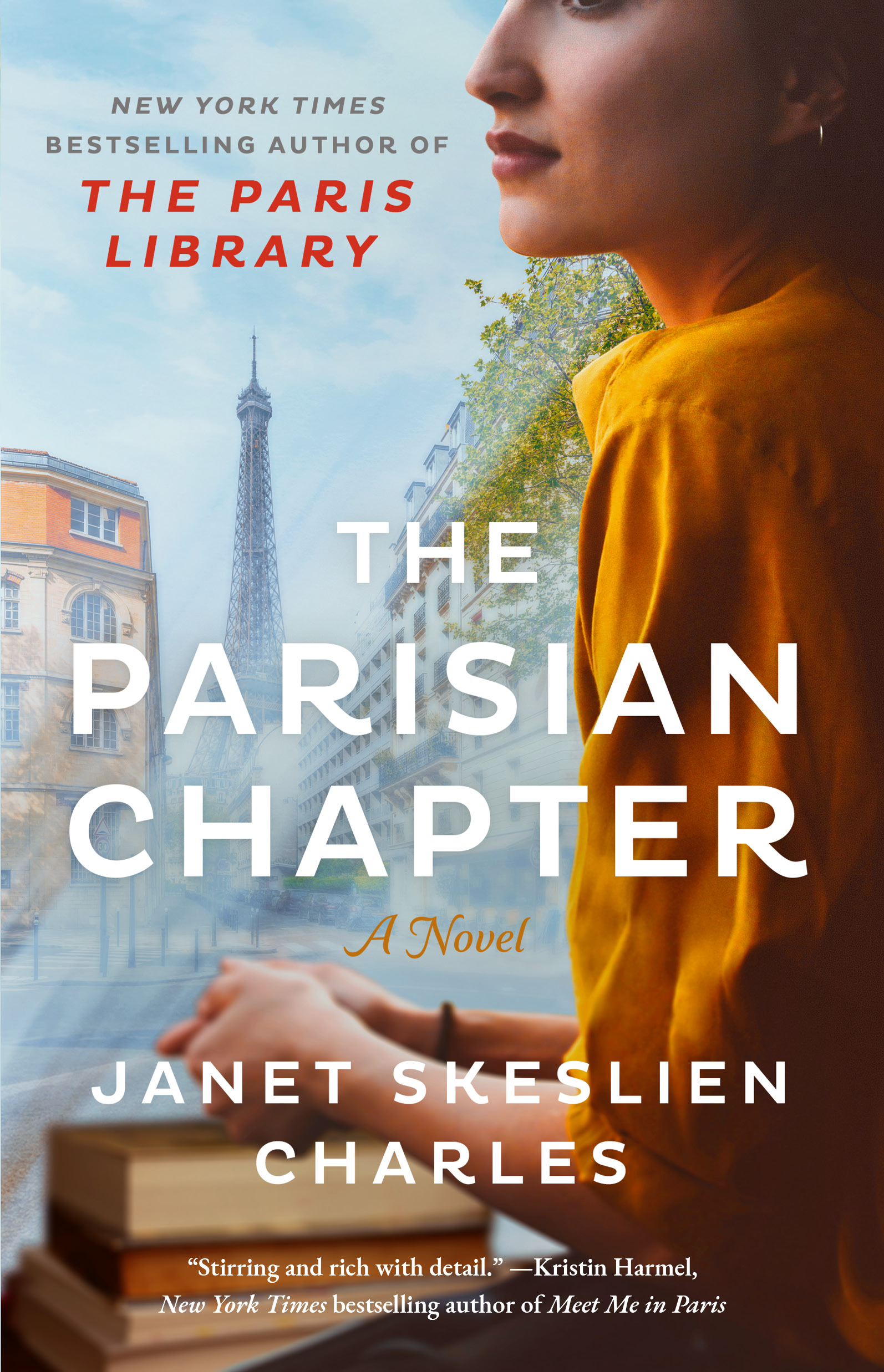
The Parisian Chapter
A Novel
Table of Contents
About The Book
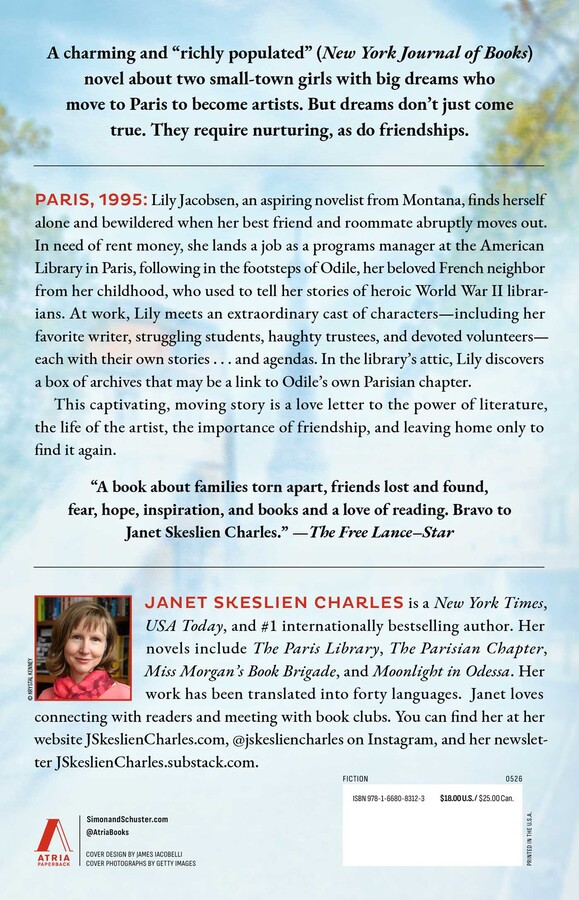
Paris, 1995: It’s been five years since Lily Jacobsen and her best friend Mary Louise arrived in Paris from their small town of Froid, Montana. Determined to establish themselves as artists, they shared a tiny walkup and survived on brie and baguettes. But when Mary Louise abruptly moves out, Lily feels alone in the city of light for the first time and needs a new way to support herself. She lands a job as a programs manager at the American Library in Paris, following in the footsteps of Odile, her beloved French neighbor in Montana who told her stories of heroic World War II librarians when Lily was growing up.
At work, Lily meets an extraordinary cast of characters—including her favorite writer, struggling students, haughty trustees, and devoted volunteers—each with their own stories...and agendas. In the library’s attic, Lily discovers a box of archives that may be a link to Odile’s own Parisian chapter.
This “stirring and rich with detail” (Kristin Harmel, New York Times bestselling author) story is a love letter to the power of literature, the life of the artist, the importance of friendship, and leaving home only to find it again.
Excerpt
Lorenzo Bruni—head librarian
I’m on the Front Line, the first librarian that people encounter when they enter the American Library in Paris. And let me tell you, people are pains. My colleagues and boss, Quentin Hayes III, have no idea what it’s like to deal with the public. Day after day, year after year, I stand at attention behind the circ desk, waiting for patrons to ambush me. Like today. Katie Hunt slinks over to return a pile of torn magazines. Her kid ripped the Family Circle to shreds, and she wants all to be forgiven. I want to shout that we’re in a foreign country—we can’t just go to the store to pick up another copy. But Hayes gave strict orders not to yell. While I’m taping pages, old Mike Roth saunters in with a baguette sandwich sticking out of his book bag. Hayes won’t let me kick him out because he paid for his membership like everyone else. Before I can inform the loudmouth that the library isn’t a picnic area, Jennifer de Narp storms over. Using her Louis Vuitton clutch as a pointer, she calls my attention to a burned-out lightbulb in the reading room and orders me to change it. I want to say that our handyman will handle it, but Hayes won’t let me refuse her. She’s one of the Select Few, insanely rich donors. While I dig the ladder out of the broom closet, Mazie Chester sneaks past in her neon-green greatcoat. It’s been a decade since she paid for a membership, but Hayes won’t let me confront her. His logic: if we’re nice to her, she’ll leave her fortune to the library instead of to Morris Templeman, her cat. This place is a revolving door of loons.
And speaking of revolving doors, another program manager left without a goodbye. Lizzy cleared off her desk and spelled out “I QUIT” with Saul Bellow paperbacks. We weren’t surprised by the resignation—not many can hack the job, or Hayes—but the choice of Bellow puzzled us. She only lasted six months before she huffed home to Auckland.
Contrary to what you might think, some people don’t want to be in Paris. Perhaps their spouse got transferred here for work, and they trailed behind. Countless writers have followed in the soused footsteps of F. Scott Fitzgerald, and they stick around because they have more pride than brains. Or like me, they came to study at the Sorbonne and stayed for love. Bound by a passion for the same subject, many of us fell for a French classmate. Reciting your vows by the light of a hundred flickering flames during a candlelit Mass at Notre-Dame seems romantic. And it is, until the love of your life cheats. By then, there are children. The French divorce court won’t allow you to leave the country—not if you want to go with your kids, anyway. I long to move back to my native Sicily to be closer to family. But until my twins turn eighteen, I’m stuck in Paris. Ten more years to go. In my parenting support group, we call it a prisoner-of-war situation.
When you live abroad, eventually—no matter your age or situation—catastrophe strikes back home. Say your mom gets cancer. You’re torn between returning to nurse her for a few months or staying put to reassure your kids, who are back to bed-wetting because of the split. You choose your children, which means your siblings—who bear the brunt of caretaking—hate you. Your mother passes, and you weren’t there. For the rest of your life, guilt is an acid that eats at you.
Any wonder people in this town are wound so tight? To escape the whiny patrons and nagging phones, I follow the nonfiction stacks from 355 (The Art of War by Sun Tzu) to 970.3 (Trail of Tears by John Ehle); skirt the spartan back office, where unlike me, support staff work without constant interruption; sneak past the land mine of Hayes’s corner office; and climb the clanging metal stairs to the Afterlife.
On this deserted mezzanine, a wingback chair and gray couch bathe in the gentle light that filters through the cracked plexiglass ceiling. Three walls teem with musty classics, while the fourth holds unpublished manuscripts. Encased in matching blue boxes, each tale is an unexpected gift. The engrossing account of a female firefighter who battles blazes and sexism, or the Algerian baker who “rises” to fame when his bread wins the premier prize in the city of Paris’s best baguette competition. I’ve read all but three manuscripts. I just want to sink in the chair to savor a story—and ten minutes of peacetime—before returning to the battlefront.
But I see that moron Roth left half of his ham sandwich on a shelf, the butter soaking into David Copperfield’s spine. I fetch a paper towel to mop up his mess.
“Hell is other people,” Sartre wrote. Certainly while sitting in the American Library in Paris.
Reading Group Guide
This reading group guide for The Parisian Chapter includes an introduction, discussion questions, and ideas for enhancing your book club. The suggested questions are intended to help your reading group find new and interesting angles and topics for your discussion. We hope that these ideas will enrich your conversation and increase your enjoyment of the book.
Introduction
From the New York Times bestselling author of The Paris Library and Miss Morgan’s Book Brigade, a charming and “richly populated” (New York Journal of Books) novel about two small-town girls with big dreams who move to Paris to become artists. But dreams don’t just come true. They require nurturing, as do friendships.
Topics & Questions for Discussion
1. Consider the epigraph of The Parisian Chapter. Do you agree that “some things do not deserve to be accepted”? What do you think is the benefit of perspective in looking back on past memories?
2. Of all the cast of characters, why do you think we’re introduced to Lorenzo Bruni first? Describe Lorenzo’s ex-pat life. Do you think it’s useful to have our first introduction to the library through the lens of someone who isn’t as enchanted by its charms?
3. What do you learn early on about Lily and Mary Louise’s friendship? Did you expect the rift between them, or were you as surprised as Lily? What are the benefits and the pitfalls of a long-term friendship like theirs? Are there any friendships in your own life that could be considered “fusionnelle”?
4. In Chapter 3, we’re introduced to Jennifer de Narp and learn that she knows both Pam and Hayes from previous encounters. Were you able to guess what both characters had done?
5. At her first Entre Nous event, Lily realizes that she wants to “create worlds to give readers respite.” This sentiment is echoed a few pages later, when Marius recalls that the silence of his childhood library was “a refuge, a relief.” Which books can you think of that have given you respite? And which places bring you the most relief?
6. Marius also observes that “there’s a certain sadness when a writer gives up, when a dream dies.” What dreams do the characters of this novel have? Do any of them end up achieving those dreams?
7. When Lily first sees Chris, she wants to know what books are at his desk, “perhaps One Flew Over the Cuckoo’s Nest, or a translation of Camus.” What book would you be excited to see at his desk? And alternately, what book would be the equivalent of a ‘literary red flag’?
8. There are many religious images in the library. For example, The Faithful come to every book event, The Afterlife is the most peaceful place in the library, and Meg is compared to Saint Peter at the “pearly revolving door.” Are there similarities between a church and a library? Are there any differences?
9. Did you expect that David was homeless? What does his life look like? How does his community help him?
10. On Lily and Chris’s first date, recounting her memories of Montana makes Lily homesick. How is her life in Paris different than her life back home? How is it better, and how is it harder? Later, at dinner with Mary Louise, she observes that “more money did not mean more fun.” How are the two girls’ lives, and experiences of Paris, diverging?
11. Up until Chapter 11, we learn about Hayes only through the eyes of others. Did reading a chapter in Hayes’ own voice change your opinion of him?
12. Lily makes the controversial decision to save Mary Louise’s paintings, even after her friend explicitly tells her to leave them in the trash. Do you think Lily made the right decision? What role do our loved ones play in preserving our dreams?
13. There are multiple pairings of women in this book: Lily and Mary Louise, Meg and Odile, Jennifer and Pam. At one point, Odile writes that “friendships, like romantic relationships, go through trials and tribulations. The important thing is not to run.” What do these women learn from one another? And what did you learn from their various friendships?
14. Many of the unpublished stories in this book are of women: Meg’s wartime memoir, Bricktop and her jazz club, Iréne Cohen’s lost novel. What is the best book you’ve ever read of a woman’s life? Was it encouraging, shocking, inspiring? Share with the group.
15. Of all the characters—the employees of the library, the trustees, the patrons, and even a ghost!—who do you wish you could learn more about? Who do you wish received an extra chapter? Was there a perspective you were particularly surprised by?
Enhance Your Book Club
1. Inspired by the employees’ love of the Dewey Decimal System, choose to either 1) find the classification number of your favorite book or 2) research the most obscure category you can find. Bring it to book club and share with the group!
2. Read The Paris Library, also by Janet Skeslien Charles, for a future book club. Does your opinion of Lily and Odile change with more information into their past lives? One theme of The Paris Chapter is how important history is to the strength of an institution, a city, and an individual. How does learning more about the American Library in Paris during World War II affect your understanding of the events in The Parisian Chapter?
3. Host your book club in the manner of a Entre Nous literary event. Lay out Brie, baguette, and Bordeaux—and feast to your hearts’ content! Play jazz in the background for the full effect.
4. Connect with Janet Skeslien Charles at her website, https://JSkeslienCharles.com
A Conversation with Janet Skeslien Charles
Q: Congratulations on publishing this exceptional follow-up to The Paris Library! What inspired you to pick this story back up? What did you learn by stretching the timeline of the story into the future?
Thank you! Would you believe that I started writing this novel before The Paris Library. As the program manager of the American Library, I jotted down funny or sad comments from coworkers and library members. At evening events, I took notes while authors spoke. The working title was “The Kicker,” in part meaning an unexpected turn of events, in part a reference to the explosive way that Lily and one of the trustees meet. I always hoped to share this story of Parisian ups and downs with booklovers, and am thrilled to hear the characters come to life.
Q: Much of this book takes place from Lily’s perspective, as she’s navigating her mid-twenties and presented with a litany of challenging circumstances—a rift with a dear friend, learning to take accountability for her actions, juggling a demanding job while seeking her life’s purpose. If you could go back and talk to your younger self at this age, what would you tell her?
When I was Lily’s age, I was too polite and gave too much to “friends” who rarely reciprocated. I worked for free in exchange for the promise of future “comp time” that was never paid. Today, people talk about “boundaries” and “matching energy.” These concepts are much needed, especially for young women, who are conditioned to respect elders (whether the elders are right or not) and to not speak out or stand up for themselves. I would tell my younger self not to be afraid to make noise. And to focus more on what I need and what I need, and to focus less on what others want.
Q: Lily makes a bad first impression when she encounters Jennifer on the street. Why did you have these two characters meet the way they did? Was there something that Lily needed to learn through this encounter?
When I transposed the story from nonfiction (my own experiences at the ALP) to fiction (Lily’s experiences), this is the first scene that came to me. It is the bed stone of the novel. There has been resistance to this scene, which I find interesting. People have no problem with novels in which women are killers, but cannot image one lashing out.
I think Lily needed to learn to communicate with the person who actually frustrated her, instead of taking out her frustrations on other people.
Q: In The Paris Chapter, Jessie Carson receives recognition through the work of Wendy Peterson. In your own life, you’ve spent a decade researching Jessie Carson. What drew you (and has continued to draw you) to her story?
In a 1918 letter to her mother, before she shipped out from New York to work in France, Jessie admitted that she didn’t have the $30 necessary to purchase a train ticket in order to say goodbye in person. That was heartbreaking to read because her mother died when Jessie was in France. Jessie also didn’t have the funds to purchase a steamer trunk for her voyage and ended up borrowing one. She was a single working woman by choice. There was no husband, no safety net of social security. Yet she traveled to a war zone to help children devastated by years of combat and destruction. I am in awe of her courage and her generosity.
Q: Lily notes that she loved when Mary Louise “talked about my favorite character like they were real people.” Do your characters become real to you? Are there any characters, whether your own or another’s, who you wish you could have a conversation with?
Absolutely! I love Janie and Pheoby from Their Eyes Were Watching God. I discovered Anne of Green Gables during Covid, and it always means so much when the right character finds you just when you need her most. When I was in the hospital for surgery, I read the Crazy Rich Asian trilogy and wanted to be friends with Astrid.
Q: You’ve done research at The Morgan Library, the NYPL, and in archives across France. What has been your experience working in all these archives? Did you conduct any research when writing this story? Was there anything you learned during your research that surprised you?
I feel so lucky to have met so many impassioned librarians and archivists. I arrived in France in 1998, just a three years after Lily began working at the ALP. I reviewed articles from the Paris edition of The International Herald tribune to confirmed what I remembered was correct.
I was surprised to learn the Gregory Peck was the speaker of the ALP gala in 1995. I wrote a scene with him, and then decided to take it out of the book. It just didn’t fit. But I loved knowing that he supported the library.
Q: Once upon a time, you were the programs manager at the American Library in Paris. What did you learn during your time there? Based on your experiences, what makes a good book event? And why do you think we are drawn to discuss books in public, even though reading itself is such a private act?
It was incredibly satisfying to bring people from all walks of life together through the fellowship of books. The events that meant the most to me were the ones that meant the most to the authors, usually the ones just beginning their careers. It’s important to nurture writers, and I was proud to invite so many from the local community. Here is a recent message I received: “Janet, I was so thrilled when Editions JC Lattès offered me your book to translate! Apart from the pleasure I took in working on it, your name brought back the happy memory of presenting my book at the American Library, and selling the first ever copy through the legendary Shakespeare and Co (I remember actually tearing up)!” Notes like this are extremely gratifying.
That is such a great question! I think because the books we love are such a pleasure to read, and we want to prolong and share that joy with others. I remember reading The Dutch House by Ann Patchett and needing to discuss the ending with every single person who’d read the book.
Q: The book cycles through the experiences of many different characters, all drawn by the pull of the library. Was there any character you wanted to give a chapter to, but couldn’t?
Yes, I would have loved to include a chapter about a colleague who was my savior when I struggled with the job. I also would have loved to have included the story of a young volunteer who helped me with evening events. Each of the real-life librarians and staff has a fascinating story, but these two in particular spoke to me.
Q: You mention a number of different books—A Tree Grows in Brooklyn, The Liars’ Club, Travels with Charley, My Antonia, To Kill a Mockingbird—that are the story “of a time and place.” How important do you think setting is in storytelling? What are some of your favorite books that create a unique and strong understanding of the place in which they’re situated?
For me, each story begins with place, because who we are is so heavily influenced by where we are from and where we are. For example, I don’t think that Lily would have lashed out like she did if she’d been back home in Montana. The Parisian Chapter is a snapshot of Paris in 1995. It might seem that not much has changed, but I feel that so much has. One small example: Lily mentions men jogging clockwise in the Jardin du Luxembourg with their pastel Lacoste collars popped. Back then, there was a certain pressure to look elegant all the time, even when exercising. There is less pressure now, and that’s a good thing.
The books mentioned above not only tell us about beloved characters, they are a priceless snapshot of a time and place. Ways of life that no longer exist as with A Tree Grows in Brooklyn or My Antonia. Or problems that sadly continue to exist in America as with Travels with Charley and To Kill a Mockingbird. I highly recommend all of them.
Q: Speaking of setting, three of your books take place in Paris. How would you describe your own “Parisian chapter”? What do you think draws so many people to the City of Light?
I would describe my chapter as a lot longer than I thought it would be! I came for “a year,” over two decades ago. I love hearing about other people’s chapters, whether it is the chapter that they lived while on their junior year abroad at the Sorbonne, or a chapter they have yet to write such as a bucket list of museums and restaurants.
Paris feels timeless, with the illusion that it is unchanging. But change happens all the time, in small ways. The city is both reassuring and yet constantly surprising. Each day, I walk down the same streets and there is always something new to notice.
Q: Are you working on anything now? If so, can you tell us about it?
I’m thinking up a few projects right now. I’d love to write another audiobook.
About The Author

Janet Skeslien Charles is the New York Times and internationally bestselling author of The Paris Library. Her work has been translated into thirty-seven languages. She has spent a decade researching Jessie Carson (Miss Morgan’s Book Brigade) at The Morgan Library, the NYPL, and archives across France. Her shorter work has appeared in the Chicago Tribune, The Sydney Morning Herald, LitHub, and the anthology Montana Noir. To connect, visit her website JSkeslienCharles.com, @JSkeslienCharles on Instagram, or @SkeslienCharles on X.
Product Details
- Publisher: Atria Books (May 5, 2026)
- Length: 240 pages
- ISBN13: 9781668083123
Raves and Reviews
“A delightful love letter to the glorious American Library in Paris. If you love Paris, don't hesitate to say 'Oui oui!' to this sparkling, heartfelt ode to libraries—and to the people who make them magical.” —Kristin Harmel, New York Times bestselling author of Meet Me in Paris
“A colorful tapestry shot through with themes of friendship, the power of books, the importance of history, and the joys and trials of an artist’s life. It’s told with charm and flair and filled with genuine joie de vivre. Francophiles, bibliophiles, and anyone who enjoys an engaging story with memorable characters will be delighted.” —Library Journal
Resources and Downloads
High Resolution Images
-
Book Cover Image (jpg): The Parisian Chapter
Trade Paperback 9781668083123
-
Author Photo (jpg): Janet Skeslien Charles Krystal Kenney(0.1 MB)
Any use of an author photo must include its respective photo credit