
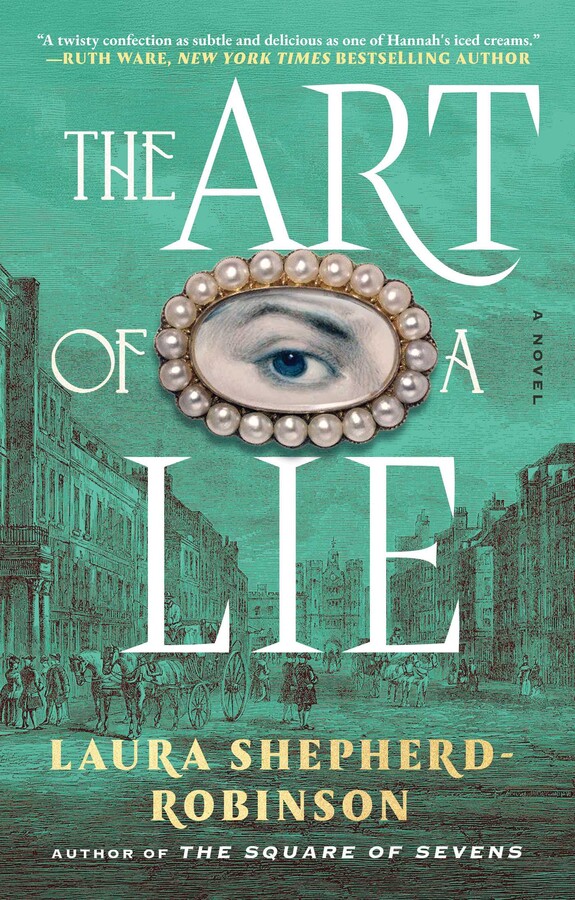
The Art of a Lie
A Novel
Table of Contents
About The Book
In 18th-century England, a widowed confectioner is drawn into a web of love, betrayal, intrigue, and a battle of wits in this “twisty” (Ruth Ware, New York Times bestselling author) historical novel from the author of the USA TODAY bestseller The Square of Sevens.
London 1749: Following the murder of her husband in a violent street robbery, Hannah Cole is struggling to turn a profit at her confectionary shop on Piccadilly as her suppliers conspire to put her out of business.
So when she learns that her husband had a large sum of money in his bank account, the surprise is, at first, extremely welcome. But her financial windfall attracts the attention of author-turned-magistrate Henry Fielding, who believes the money might have been acquired through ill-gotten means and seeks to confiscate it.
Endeavoring to prove otherwise, Hannah enlists the help of William Devereux, a friend of her late husband, who also tells her about a new Italian delicacy called “iced cream,” which she believes might transform the fortunes of her shop. As she and Devereux delve into the mysteries of her husband’s double life in Georgian London’s gambling dens, Hannah unravels secrets even more devastating than his murder.
Excerpt
CHAPTER ONE
NINE TIMES OUT of ten, when a customer walks into the Punchbowl and Pineapple, I can guess what will tempt them. It is the confectioner’s principal art, anticipating wants and needs—and people betray their desires in countless small ways. For a young lady taut with nerves, dressed to make a house call, I suggest a pretty basket of French macaroons to impress her friends. For a young buck in the first flush of love, seeking a gift for his mistress, I propose a petits puits d’amour (the name and oval shape might make him smile, though I act oblivious to any indelicate connotations). For an older gentleman—picture one crimson from hunting and port—a rich plum cake spiced with cinnamon and mace. For a widow in mittens, a box of scented violet wafers—or if she is bent with the rheumatism, bergamot chips. For a little boy with a cough, I prescribe a guimauve : a soft cake of honey whipped with the sap of the marsh mallow plant. And for his governess, a sweet syllabub, to be eaten at one of my tables, while she ponders how life’s misfortunes brought her here.
That day, the fifteenth of June 1749, I was watching a gentleman in the mirror behind my counter. He’d just strolled in, escaping the bustle of Piccadilly, remarkably unsullied by the dust and heat of the day outside. His finger hovered over my golden nests of spun sugar, each filled with marchpane eggs and topped with a sugar-work bird—a new creation I’d put my hand to whilst the shop had been closed for mourning. Like my birds, he was a colorful creature—his coat a smoke-blue silk with silver embroidery at the collar and cuffs, a topaz pin in his cream cravat, and a plump meringue of a periwig beneath a smoke-blue hat adorned with a peacock feather. The patina of the mirror speckled his tawny skin, the warp of the glass distorting one golden-brown eye.
Not a sugar nest, I thought, not unless he was looking for a present for his wife—and he had taken a stool at my counter, which suggested he intended to eat. An apricot tart, I decided. Refined, yet unadventurous, like most of my customers.
To my surprise, he pointed to a silver tureen, where half a dozen glass goblets of ice shavings nestled amidst larger shards of ice. “Is that a Persian sherbet?” he said. “I haven’t had one in years.”
“Perfect for the weather, sir,” Theo said.
I could imagine how she’d be looking at him. Fifteen years old, and men still a mystery she presumed delightful. “The goods are behind the counter,” I’d sometimes remind her. “Not in front of it.”
“I’ll do it,” I said, turning. “Go see to the balancing pan.”
“Yes, Mrs. C.” Theo gave me a pert look, and threaded her way, hips swaying, to the door at the back of the shop.
Undistorted by the mirror, the gentleman appeared slightly familiar, though I couldn’t quite place him. Perhaps from church? A carriage moved on the street outside, and a shaft of sunlight gilded his face, revealing a few delicate lines of age around the eyes and mouth. He put up a hand to shield his gaze, signet ring flashing.
I poured a syrup of rosewater over one of the goblets of ice, adding a scatter of dried rose petals and ground Turkey pistachios. The gentleman handed over the coins and while I weighed them, he plunged in with his spoon.
“Your girl wasn’t wrong,” he said, after a moment. “That’s perfection right there.”
I inclined my head at the compliment. “Most find the flavors too exotic.”
He grinned. “Round here they still say that about a peppercorn.”
He’d get no warm words from me, a widow of nearly thirty. Yet I was still pondering the mystery of where I had seen him before. Once I’d secreted the coins in my money-drawer, my curiosity got the better of me. “Do I know you, sir?”
His smile faded. “We’ve not been introduced, but I attended your husband’s memorial service. William Devereux is my name. My condolences, Mrs. Cole. Jonas was a general, a true force. I can hardly believe that he’s gone.”
People think it’s what you want to hear. To know that the man you loved mattered. That his qualities were recognized, that he is remembered. How could they know that every morning when I awoke, I put my shoulder to the grindstone of forgetting? Here in the shop, I could pretend that none of it had happened. That Jonas was out on parish business, or had popped upstairs to fetch a spool of ribbon or a clean apron. It brought me a measure of peace, just for an hour or two, until some well-meaning customer like Mr. Devereux brought it all back. The punch in the gut, the sick wave of fear for my own future.
Mr. Devereux was watching me with evident concern. “I have something for you,” he said, holding out a folded piece of paper. I found myself gazing at an official-looking document with a stamp and a seal.
“I advise gentlemen on the prudent investment of their money,” he explained. “Jonas was a client of mine. Acting upon my counsel, your husband placed ten pounds with the Culross Iron and Coal Company. I am pleased to say that this is the dividend from the first quarter.” He smiled and handed me a silver crown.
“Ten pounds?” I said, knowing nothing of this investment, trying to keep the eagerness from my tone. “Is it possible to redeem that money now?”
“Not for the moment, I’m afraid. But all being well, you can expect to see around five or six shillings every quarter, with the stock becoming redeemable in nine months’ time.”
Five shillings was still five shillings. Every penny mattered now. Since reopening the shop after Jonas’s murder, everything had proved a struggle. Summer was always the worst time of our year—the nobility and gentry having fled the swelter of the city for Bath and Tunbridge Wells—and widowhood had brought new challenges to my trade.
“I’d only known Jonas a few months,” Devereux went on. “We met by chance in the bank and got to talking. It led to a fledgling friendship. We drank together sometimes—at the Running Horse or the Star and Garter.” He sighed. “Are they any closer to finding the villains responsible?”
I shook my head rather bleakly, and Devereux had the good grace to look away, rattling his spoon against his glass to scrape up the last of the syrup. “Delicious,” he pronounced. “Though it’s iced cream that I truly dream of in this weather.”
Grateful for this rather clumsy effort to change the subject, I studied him quizzically. “Iced cream, sir?”
“My mother used to make it when I was a boy. She was raised in Italy, and it is a great delicacy over there. Mother used to flavor the cream with peach or elderflower and then it was frozen almost solid. I used to think it was like biting into a snowball—though snow never tasted so good.”
His words intrigued me. Even before Jonas’s death, I’d been convinced that our shop required innovation if we were to stand out from our competitors. Now my need to entice new customers through the door was rather more pressing.
“Do you know how it is done?” I asked. “Freezing cream, I mean?” I had never seen, nor heard of frozen liquids other than water.
“I am afraid I only ever enjoyed the end result,” Devereux said. “Many years later I tried it again, on the Piazza della Signoria in Florence. But it was sold from a pail, so I saw none of the preparation.”
A woman in a wide yellow hat approached the counter and I noticed her steal a second glance at Mr. Devereux. “What is that?” she asked, pointing.
“A simple pound cake, madam,” I said, “but filled with a Seville orange cream. It’s like a burst of sunshine in your mouth.”
Her lip quivered. “I’ll take six of those almond wafers.”
I turned to box up her purchase, and Devereux met my eye in the mirror. “Too exotic,” he mouthed.
I was still frowning at his presumption when Theo returned. “Mr. Brunsden is come to settle his bill.” She set down a tray of lemon jellies and smiled at Mr. Devereux.
Restraining a sigh, I excused myself. As I passed through the shop, my little jewel box of gilt-edged mirrors and pistachio paneling, I exchanged a few words with my regular customers. Entering the hot, sweet hell of my kitchen, I found Oscar sweating over the pastry table, stamping out almond hearts. Not quite trusting Theo with the shop’s money yet, I told Oscar to watch the counter and to send in Felix to take the goods down to the cellar. Then I smoothed my apron, and walked out into the yard.
Roger Brunsden was resting upon his cane in the shade of the old vine that had colonized my back wall and those of the neighboring yards. His boys trooped in and out of the alley, grunting under the weight of sacks of flour and salt, sugar loaves wrapped in blue paper, boxes of dried figs and currants.
He greeted me with an elaborate bow, then handed me his bill. “That time again, I am afraid, Mrs. Cole.”
Brunsden had the manners of a marquis and the accent of a Thameside stevedore. Sweat crawled from beneath his periwig, staining his cravat yellow with some kind of scalp oil. His pink, piggish eyes, fringed by bristling white lashes, traveled over my purple gown.
“Black was rather too somber for my customers,” I said, regretting it immediately. I didn’t owe Roger Brunsden or anyone else an explanation.
“Not for me to judge,” he replied, unsmiling.
I studied his bill. “But this is more than a usual month,” I cried. “We only reopened two weeks ago.”
“The price of sugar isn’t what it was,” he said. “Nor the price of wheat.”
I didn’t believe his excuses, not for a moment. He just didn’t like women in trade—and was seeking to take advantage of my lack of experience with the books. Nor was he the only one. Between him, the fruiterer, and the egg man, I’d be lucky to break even that month. “Give me five minutes with a paring knife,” I’d exclaimed to Oscar in frustration, “and I’ll pit their stony hearts like Morello cherries!”
Reluctantly, I parted with my coins and returned to the shop. Mr. Devereux had gone, and Oscar glanced pointedly at a gentleman of middling years who was sitting in his place at my counter. Fearing he’d also come to collect on a bill, I slowed my pace.
His broad shoulders were hunched, his giant body contorted awkwardly upon the stool, one tree trunk of a leg stuck out to the side as if it was injured. His clothes were very fine—burgundy silk, a good French lace—but rather disheveled in the wearing, his cravat and wig askew, his coat misbuttoned. The intensity of his gaze suggested a fierce curiosity about the world, whilst the imperious jut of his long chin (which nearly met his long, curved nose) and the curl of one great fist upon the counter implied a determination to leave his stamp upon it.
He turned as I approached. “Mrs. Hannah Cole?” he said. “My name is Henry Fielding, the chief magistrate of Westminster. I’d like to talk to you about your husband’s murder.”
About The Author

Laura Shepherd-Robinson was born in Bristol in 1976. She has a BSc in politics from the University of Bristol, an MSc in political theory from the London School of Economics, and an MA in creative writing from City St. George’s, University of London. She is the author of four novels, Blood & Sugar, Daughters of Night, The Square of Sevens, and The Art of a Lie. She lives in London with her husband, Adrian. Find out more at LauraShepherdRobinson.com.
Product Details
- Publisher: Atria Books (August 5, 2025)
- Length: 304 pages
- ISBN13: 9781668083093
Raves and Reviews
“A lively tale of double-dealing and subterfuge."
—New York Times Book Review
“A twisty confection as subtle and delicious as one of Hannah's iced creams. I loved it.”
—Ruth Ware, New York Times bestselling author
“Astonishing. The Art of a Lie is Laura Shepherd-Robinson at the height of her considerable powers. Of course it’s beautifully written and richly detailed, but it’s also fiendishly twisting and properly thrilling. A rare and wonderful story.”
—Chris Whitaker, New York Times bestselling author of All the Colors of the Dark
"This book has a notably perfect ending. . . . A flirtatious cat-and-mouse game ensues, with heart-rending results."
—Crimereads
"How I long to visit the Punchbowl and Pineapple on Piccadilly . . . I simply couldn’t look away from The Art Of a Lie. A story as sweet as ‘iced cream’, as tense as spun sugar, as clever as a trickster and as beautifully written and masterful as everything by the wonderful Laura Shepherd-Robinson. An absolute treat of an historical crime novel. Sheer perfection."
—Janice Hallett, bestselling author of The Appeal
“A richly textured narrative, reminding us that Shepherd-Robinson has few equals in the field of the historical crime novel.”
—Financial Times
"A delicious romp of cat and mouse infused with sumptuous plotting, The Art of a Lie is a novel of rich delectable appetites to be savoured right to the very last chapter."
—Susan Stokes-Chapman, bestselling author of Pandora
“Nothing short of exceptional. . . . meticulously researched and with writing as carefully, delicious crafted as the sweets filling its pages.”
—The Bookseller (UK)
"The Art of A Lie is a delicious mystery and I savoured every twist and turn. An impeccably atmospheric, startling and clever historical thriller that kept me guessing to the final page. Completely brilliant!"
—Jennifer Saint, bestselling author of Ariadne
“A thrilling ride through the streets of 18th century London, full of twists and turns, unforgettable characters, evil deeds and delicious food.”
—Elly Griffiths, author of The Stranger Diaries
“Richly imagined, fiendishly clever and twisty as hell, this an up-past-midnight page turner from a writer at the top of her game. An absolutely glorious cat-and-mouse tale.”
—Ellery Lloyd, author of The Club
“The queen of historical crime has done it again: The Art of a Lie is a propulsive, twisty and immaculately researched mystery, bringing the grime and glamour of Georgian London to roaring life.”
—Caroline Lea, author of The Glass Woman
"A glorious tale of men and women with secrets, love and heartache, deceptions and comeuppances.. and oh I want an ice-cream now. Historical but also thematically current, highly recommended!"
—Sarah Pinborough, author of Behind Her Eyes and Insomnia
“This book is an absolute treat, with deceit layered on deceit. As always, Laura brings Georgian London to life in all its wit and wickedness. I devoured the story like a bowl of fresh iced cream, and I won't be able to walk the length of Piccadilly without thinking of Hannah Cole and her shop of sweet temptations.”
—SJ Bennett, author of The Windsor Knot
“Exquisitely drawn and meticulously researched, fast-paced and tightly plotted and full of heart. This gorgeous novel had me turning pages late into the night, and I am still thinking about its two brilliant protagonists long after finishing the final chapter. In a word: decadent.”
—Elizabeth DeLozier, author of Eleanore of Avignon
"Switchbacks and reversals to beat a rollercoaster with an attention to historical detail that had my mouth watering on occasion. I think it’s [Laura Shepherd-Robinson's] best yet, and I don’t say that lightly."
—Harriet Tyce, bestselling author of Blood Orange
"In this novel, Laura Shepherd-Robinson displays the art of a truly masterful storyteller: it is captivating, compelling, and so, so clever, but like all the best stories it will capture your heart. It is as exquisite as the iced cream that Hannah Cole concocts and long after you have finished you will not be able to forget it. I absolutely adored it and cannot recommend it highly enough."
—Jo Callaghan, bestselling author of In The Blink of An Eye
"I absolutely loved this book. A deliciously clever and complex confection of love, artifice, mystery and ice cream, with exquisitely drawn characters. Laura Shepherd-Robinson’s best book yet."
—Anna Mazzola, author of The Book of Secrets
“Laura Shepherd-Robinson has excelled herself with this most artfully constructed novel, which toys with our emotions and plays havoc with our expectations. She has an instinctive feel for the textures of eighteenth-century life—and an almost supernatural knowledge of contemporary confectionary skills and the art of the sophisticated con-trick. Read and enjoy. Historical crime fiction doesn’t get any better than this.”
—Andrew Taylor, bestselling author of The Ashes of London
“An irresistible confection to beguile, bemuse, and delight ... with a slither of ice at its heart.”
—Essie Fox, author of The Fascination
“A fast-paced historical narrative that pits two protagonists against each other in a wily battle of wills. Confident, engrossing, and as taut as any thriller.”
—Vaseem Khan, author of Midnight at Malabar House
“A spellbinding, utterly immersive, meticulously researched novel that grips as a thriller and yet also plunges the reader into a fully realised and vibrant world. The work of a master storyteller.”
—William Hussey, author of The Boy I Love
Resources and Downloads
High Resolution Images
-
Book Cover Image (jpg): The Art of a Lie
Hardcover 9781668083093
