
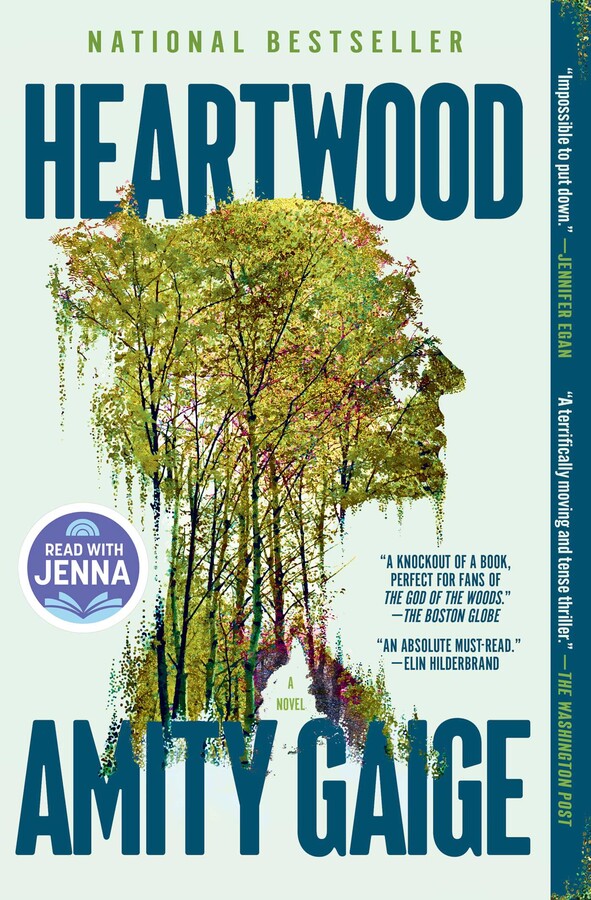
Heartwood (A Read with Jenna Pick)
A Novel
Table of Contents
About The Book
“The best thriller of 2025.” —The Boston Globe * “Genius.” —The Washington Post
“A literary thriller of the highest order” (Elin Hilderbrand, New York Times bestselling author of The Perfect Couple), Heartwood takes you on a gripping journey as a search and rescue team race against time after a woman mysteriously disappears on the Appalachian Trail.
In the heart of the Maine woods, an experienced Appalachian Trail hiker goes missing. She is forty-two-year-old Valerie Gillis, who has vanished 200 miles from her final destination. Alone in the wilderness, Valerie pours her thoughts into fractured, poetic letters to her mother as she battles the elements and struggles to keep hoping.
At the heart of the investigation is Beverly, the determined Maine State Game Warden tasked with finding Valerie, who leads the search on the ground. Meanwhile, Lena, a seventy-six-year-old birdwatcher in a Connecticut retirement community, becomes an unexpected armchair detective. Roving between these compelling narratives, a puzzle emerges, intensifying the frantic search, as Valerie’s disappearance may not be accidental.
Heartwood is a “gem of a thousand facets—suspenseful, transporting, tender, and ultimately soul-mending,” (Megan Majumdar, New York Times bestselling author of A Burning) that tells the story of a lost hiker’s odyssey and is a moving rendering of each character’s interior journey. The mystery inspires larger questions about the many ways in which we get lost, and how we are found. At its core, Heartwood is an “unputdownable” (Real Simple) and redemptive novel, written with both enormous literary ambition and love.
Excerpt
Any woodsman who says he’s never been lost in the woods is a liar. It’s inevitable. Up here in the North Woods, everybody goes woods queer now and again. That’s because we spend so much time outdoors. Ice fishing, hunting. Kids grow up following their parents into the backcountry, where they learn the basics of outdoor survival. How to build a camp. How to dead reckon by the sun. Up here, we tend to think of being lost as something you can be good at.
I’ve been in the business of finding lost people in the woods for thirty years. I know how hard it is to keep a clear head when lost. The disorientation can be shattering. A lost person is like the believer who is told “There is no God.” After that, everything seems like a lie. But loss of mental control is more dangerous than the lack of food or water. Panic crowds out common sense. It makes the lost person crave a quick, easy solution.
Imagine you’re her. Valerie Gillis. You have been hiking for a long time. Three months. You’re no young lass, though you’re tougher than you thought you were. Like a lot of people, you’d always wanted to hike the legendary Appalachian Trail. Since taking the plunge, you have hiked through mud, water, pain, and heat. Maine is even harder than you heard it would be. One difference is the density of the woods. Walls of vegetation hem you in on both sides. In the past, when the trail got hilly and punishing, you stared at your boots, willing yourself forward one step at a time. But now, you raise your head. You pause. Somehow, for some reason, you step off the path. Maybe you’ve seen something—a rare bird or flower. Or maybe you just need to pee and want some privacy. Hikers are supposed to chug two hundred paces away from the trail before they urinate, and you’re a polite person. Or you’re spooked by a sound in the woods, voices approaching. You step off the path and fight your way through the head-high saplings and sticky bushes. You look up at the sky, which is barely visible through the dense, netted canopy.
Time passes.
Rested, relieved, you look for the path. Ten steps, twenty. Nothing. But the path was right there. You don’t backtrack. Lost people seldom do. Rather, you push on farther, because you are dead certain this is the direction you came from. Every direction you turn, the view is identical, a claustrophobic wall of foliage and shrubbery. You wade forward into the mass of vegetation.
You begin to run. Branches beat your head. Buckthorn snares your feet. Brambles tear your skin. You’re desperate to get a view, to reorient, to understand.
We frequently find lost people looking very beat-up. They’ve been lanced by thorns and snags. Their clothes are filthy and ripped or even torn off from falling down or crawling or stepping into dangers they would have otherwise seen.
That’s what the terror of being lost makes people do.
By the time they get up here, northbound Appalachian Trail hikers have trod 1,900 miles. The class of hikers that starts as a mob down in Georgia really thins out by the end of the season. The beleaguered few who make it up here are an ugly bunch. They are very close to their goal, but it seems to me there’s something about the proximity to the finish that makes them lose focus. They tend to wander off, to break down physically or mentally.
That, I understand.
Dreams burn a wildfire in a body. It’s worth it, but there’s no coda.
This year seems worse than normal. The AT was officially closed for thru-hiking for the first time in history when the pandemic hit in 2020. I question the readiness of some of the folks out here this season.
You can’t get lost on the AT, they all say. But here at the Maine Warden Service, we get several dozen calls for lost thru-hikers every season. Maine is the worst place on the AT to get lost. It’s a whole new kind of hiking, more remote than anything that’s come before. Not much farther north than where Valerie Gillis was last seen lies the Hundred-Mile Wilderness. At the trailhead looms a sign that reads, verbatim: Do not attempt this section unless you have a minimum of 10 days supplies and are fully equipped. This is the longest wilderness section of the entire A.T. and its difficulty should not be underestimated.
Seems appropriate that the architects of the Appalachian Trail put the northern terminus on the other side of these woods. As the hikers say, “No Maine, no gain.”
To search is to guess. If the location of the lost person is known, that’s a rescue, not a search. A lost-person search begins with a couple of knowns and a whole busload of conjecture. If that sounds hard, it is. I always bear in mind that a century ago, the work I do was conducted with no GPS, no CB radio, no sidearm. Just a couple of guys in beaver skins tramping through the snow.
Here’s what we know. On the morning of Monday, July 25, Valerie Gillis awoke early at Poplar Ridge shelter, said goodbye to two female southbound hikers with whom she’d bonded the night before, and continued her journey north. She had a cell phone and appropriate gear and supplies, and was in a fine mood. There’s no cell service on that stretch of trail, but her husband was set to pick her up for resupply at a trailhead the following day. She was almost done with the northern portion of her hike. She smiled for a snapshot just as she turned to leave.
Then she vanished.
The husband waited a day to report Valerie lost. It was common for Valerie to be waylaid at a meetup, so he didn’t panic on Tuesday. He panicked on Wednesday. That evening, we send a crew of wardens out to the shelters on foot in the hope that we run into Valerie ourselves, as often happens on a hasty search. Overdue hikers are frequently found trailside dehydrated or with a broken ankle.
We come up empty. All we get on Wednesday is a lead from a teenaged hiker who runs into a warden in a parking lot thirty miles to the north. He says he saw a middle-aged woman sitting on a rock “looking played out” near Spaulding Mountain shelter the day before. Lacking anything stronger, I designate this as our point last seen. We find the two southbound women who saw her leave Poplar Ridge shelter as they are provisioning in town. They give us the photo—perfect. When I get home, I settle at my kitchen table under a cone of light to study my maps of the search area. Only eight miles stretch between Poplar Ridge shelter and the next shelter north, Spaulding Mountain. But because there is no point of exit between the two shelters, the search area broadens to thousands of acres of conifers, fallen trees, rocks, streams, and hobblebush. Numerous unnamed ridges rise and fall like waves with a short fetch. There are no settlements to speak of in any direction for many miles.
It’s long past midnight by the time I put away my area maps. I spread my old Appalachian Trail map on the table. The trail is named for the mountains that span the entire eastern coast of this country, north of the Gulf Coastal Plain all the way to Canada. And through this range wends one long, continuous footworn path. Georgia. North Carolina. Tennessee. Virginia. West Virginia. Maryland. Pennsylvania. New Jersey. New York. Connecticut. Massachusetts. Vermont. New Hampshire. Maine. The trail does not follow the low ground of valleys, nor does it circumvent obstacles. Instead, it goes tramping over countless summits, straight across streams; it marches into towns and occasionally humps down highways. The trail moves like a story. Sometimes it makes sense and sometimes it doesn’t. The trail wanders like a vagabond. Here it veers toward the impractical, there toward opportunity. How much thought must have been put into its route, and how much agreement. Southerners and northerners clearing a fourteen-state corridor to make way for a humble footpath.
I stare at the map for a long, long time.
Valerie’s whereabouts are somewhere right in front of me.
As soon as I hear the first birdsong, I pack a bag and get in my truck.
Reading Group Guide
Talk about how you felt as Valerie described her lostness. What do you think you would feel or do if you became lost in the outdoors?
Valerie writes letters to her mother while she is lost in the woods. Who would you write to and what would you want them to know?
What do you think about the novel's connection between lostness and being motherless?
For many readers, Santo is a surprising favorite character. What did you think about his role in the investigation and his friendships with Valerie and Cody the warden?
Heartwood is as much about being lost as it is about being found. What times in your life have you been “lost” emotionally, spiritually, or psychologically, and who rescued you?
Heartwood was written during the pandemic and Lena was inspired by how difficult quarantine was for older people. Did reading Heartwood remind you of that difficult time? And was there anything you turned to, like reading, internet-sleuthing or hiking, that helped you get through it?
Though there are true stories of people going missing while hiking, there is also a vibrant and supportive trail community. The book is in many ways a celebration of the American wilderness. Did reading Heartwood make you want to hike the Appalachian Trail?
About The Author

Heartwood is Amity Gaige’s fifth novel. It was selected by Jenna Bush Hager as a Read with Jenna pick for April 2025 and became an instant national bestseller. Amity is the author of four previous novels, O My Darling, The Folded World, Schroder, and Sea Wife. Sea Wife was a 2020 New York Times Notable Book and a finalist for the Mark Twain American Voice Award. Schroder was also a New York Times Notable Book and a best book of 2013 according to The Washington Post, The Wall Street Journal, among others, and was shortlisted for UK’s Folio Prize in 2014. In 2018, Amity was awarded a Guggenheim Fellowship in Fiction. She lives in West Hartford, Connecticut, with her family and teaches creative writing at Yale.
Product Details
- Publisher: Simon & Schuster (January 27, 2026)
- Length: 320 pages
- ISBN13: 9781668063613
Resources and Downloads
High Resolution Images
-
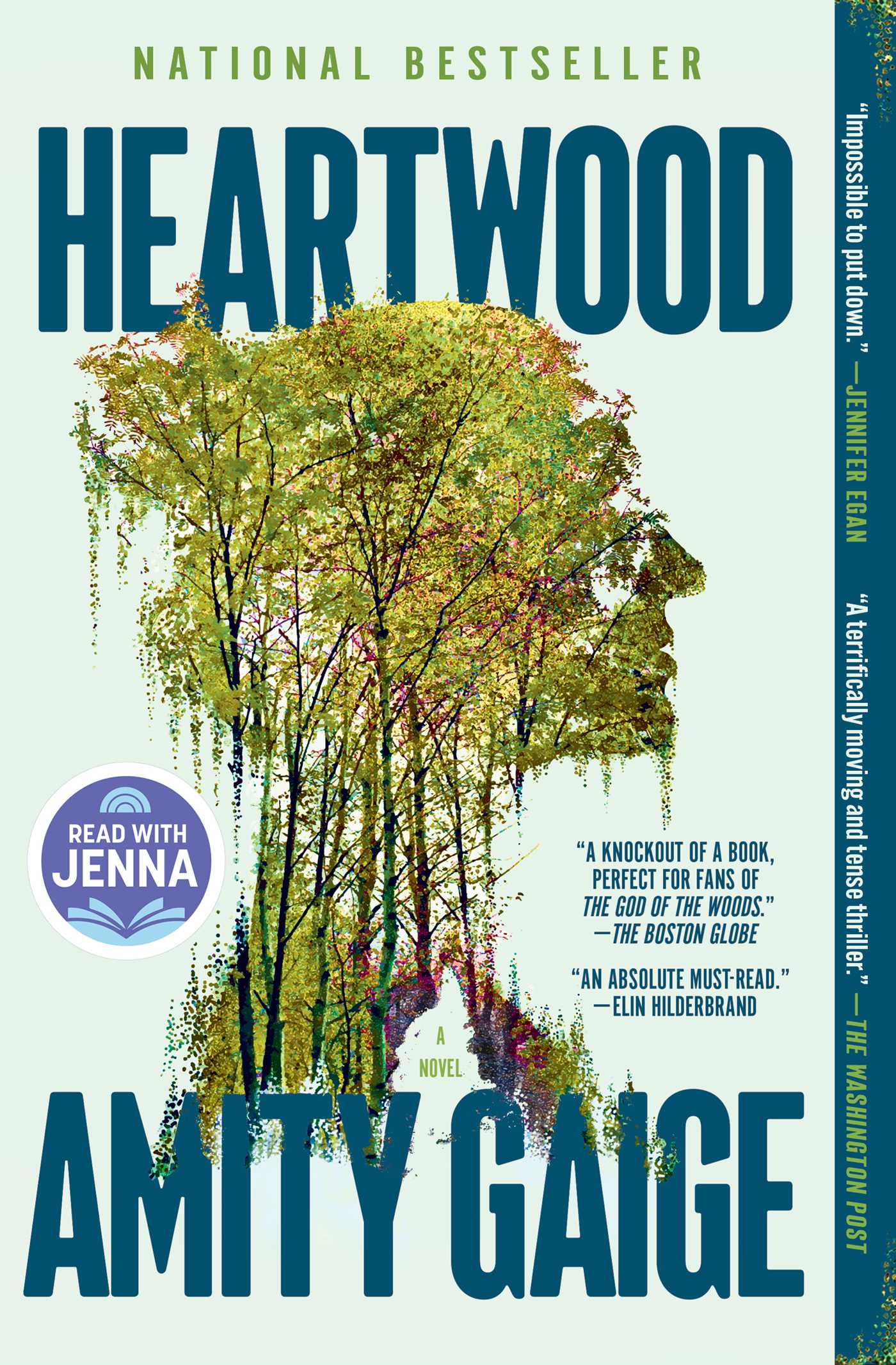
Book Cover Image (jpg): Heartwood (A Read with Jenna Pick)
Trade Paperback 9781668063613
-
Author Photo (jpg): Amity Gaige Jane Shauk(0.1 MB)
Any use of an author photo must include its respective photo credit
