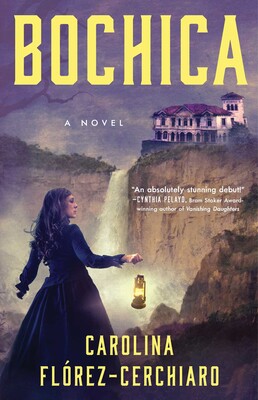
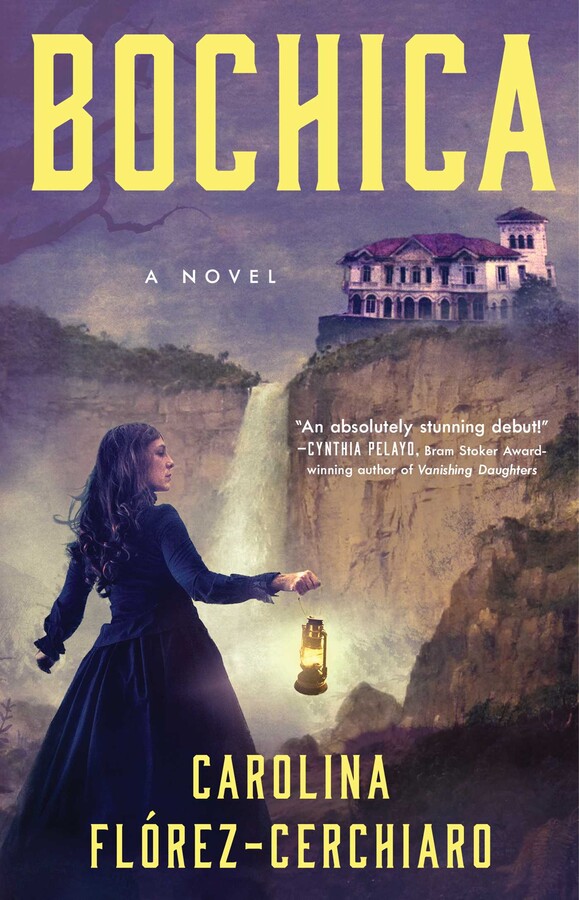
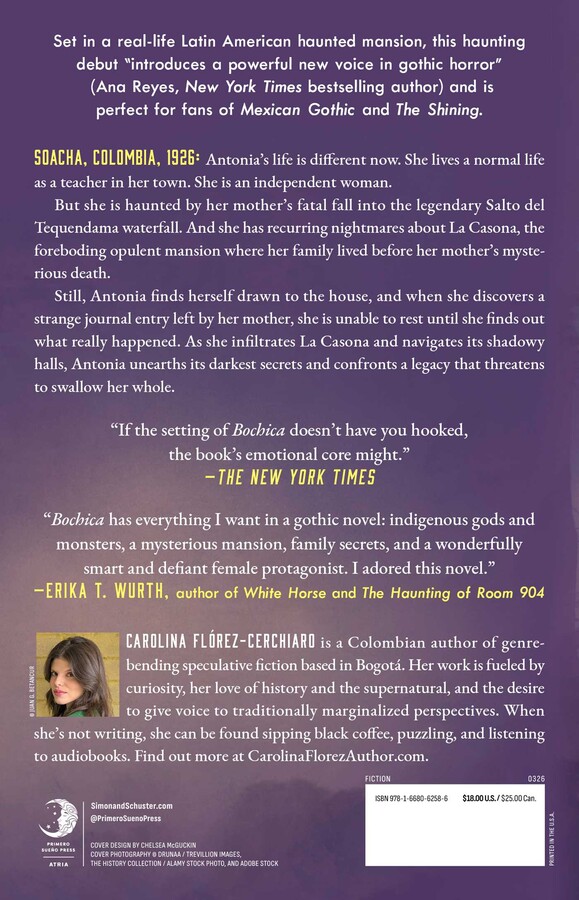
Bochica
A Novel
By Carolina Flórez-Cerchiaro
Table of Contents
About The Book
“An absolutely stunning debut!” —Cynthia Pelayo, Bram Stoker Award–winning author of Vanishing Daughters
A real-life Latin American haunted mansion. A murky labyrinth of family secrets. A young, aristocratic woman desperate to escape her past. This haunting debut “introduces a powerful new voice in gothic horror” (Ana Reyes, New York Times bestselling author) and is perfect for fans of Mexican Gothic and The Shining.
In 1923 Soacha, Colombia, La Casona—an opulent mansion perched above the legendary Salto del Tequendama waterfall—was once home to Antonia and her family, who settle in despite their constant nightmares and the house’s malevolent spirit. But tragedy strikes when Antonia’s mother takes a fatal fall into El Salto and her father, consumed by grief, attempts to burn the house down with Antonia still inside.
Three years later, haunted by disturbing dreams and cryptic journal entries from her late mother, Antonia is drawn back to her childhood home when it is converted into a luxurious hotel. As Antonia confronts her fragmented memories and the dark history of the estate, she wrestles with unsettling questions she can no longer ignore: Was her mother’s death by her own hands, or was it by someone else’s?
In a riveting quest for answers, Antonia must navigate the shadows of La Casona as she unearths its darkest secrets in this “delicately told story of how the past always finds us—and how people can be haunted just as surely as places can” (Hannah Whitten, New York Times bestselling author).
A real-life Latin American haunted mansion. A murky labyrinth of family secrets. A young, aristocratic woman desperate to escape her past. This haunting debut “introduces a powerful new voice in gothic horror” (Ana Reyes, New York Times bestselling author) and is perfect for fans of Mexican Gothic and The Shining.
In 1923 Soacha, Colombia, La Casona—an opulent mansion perched above the legendary Salto del Tequendama waterfall—was once home to Antonia and her family, who settle in despite their constant nightmares and the house’s malevolent spirit. But tragedy strikes when Antonia’s mother takes a fatal fall into El Salto and her father, consumed by grief, attempts to burn the house down with Antonia still inside.
Three years later, haunted by disturbing dreams and cryptic journal entries from her late mother, Antonia is drawn back to her childhood home when it is converted into a luxurious hotel. As Antonia confronts her fragmented memories and the dark history of the estate, she wrestles with unsettling questions she can no longer ignore: Was her mother’s death by her own hands, or was it by someone else’s?
In a riveting quest for answers, Antonia must navigate the shadows of La Casona as she unearths its darkest secrets in this “delicately told story of how the past always finds us—and how people can be haunted just as surely as places can” (Hannah Whitten, New York Times bestselling author).
Excerpt
1. Uno UNO
ONE IS ALWAYS SUBJECT TO THE INFLUENCE OF SPIRITS
Antonia rested her weight against the wooden desk and stared at the words carved on the gray concrete wall above the blackboard. She didn’t appreciate the reminder because she didn’t believe the words to be true, but the nuns insisted that the girls should learn about the weaknesses of the flesh and the soul.
The hazy gloom of burned incense settled in the room, but it didn’t mask the earthy graveyard smell. The nogal’s dead branches click-clacked off the half-open arched stained-glass windows; cold lurked inside, crawling up her nostrils, creeping down her throat. Antonia swallowed. When would this oppressive gloom finally pass over Bogotá?
Rain droplets pelted her face. Antonia pulled up the zipper of her black woolen coat and rushed through the young girls—bent over their notepads on their weathered wooden desks—to shut the windows, then patted her hands dry against the thick fabric of her black dress.
Antonia glanced briefly at her students, and at hand’s reach were the Catechism and the Bible. Antonia shook her head; the girls spent hours being told what to say and think.
While boys learned math, algebra, and geometry, girls learned all about domestic economy. Nothing more than simple mathematical operations were required.
Although Antonia had been working at the Escuela para Señoritas de Bogotá for over a year, she still wasn’t used to what the nuns called “the nourishing of the minds of the youth.”
Girls were taught manners; how to be good daughters, docile and benevolent ones, and obedient and caring future wives and mothers. The majority of them would be married by the age of fourteen. And if they were lucky, marriage wouldn’t come until they turned eighteen or twenty. But those were exceptions. And even then, they’d remain in captivity. Captive to their condition as females. Doomed to a life at the service of men, determined by religious beliefs.
For when a woman dared escape home, it was frowned upon. A woman’s duty could only be housework.
There was nothing that could even make them consider the idea of leaving.
For a while, Antonia had longed for an escape regardless of what people would say. She’d daydreamed about Paris, London, Rome, and Istanbul. About studying the origins of Gothic literature where it had all begun.
Unlike these girls, who attended Catholic school, when Antonia was a child, she had, for the most part, been tutored by Carmela in math, algebra, and geometry. Still, Antonia’s position in life was no better than that of any other woman.
So, here she was.
Just a few more hours until the day was finally over. She snapped out of her stupor and continued with the lesson:
“But the influence of the demons, as we know from the scriptures and the history of the Church, goes further still….”
Antonia wished she could tell the girls that demonic possession was as much of a fantasy as every other folktale they’d been told. Such as La Llorona—the spirit of a grieving woman in search of her dead kid—or La Patasola, a one-legged woman-like creature with vampire-like lust for human flesh and blood.
Antonia’s stomach churned at the notion that in 1936 Colombia, monsters were female.
“The Devil may attack one’s body from without or assume control of it from… within.” Antonia parsed through her words as her gaze fixated on the girls stiffening in their seats, panic flaring in their eyes. This was terrorism.
She placed the Catholic Encyclopedia on top of her desk; her brown eyes stared at the navy-blue leatherbound behemoth of a book for a bit. Her chest tightened. She was complicit in this brainwashing.
A hand rose at the back of the dimly lit classroom and brought Antonia’s focus back to her audience. She nodded, and a black-haired girl stumbled away from her desk.
“Miss Rubiano, how do we know…” The girl paused, her elbows pressed into the sides of her beige uniform, making her look even smaller. “How do we know when someone’s possessed by the…” The girl’s voice trailed off as though she couldn’t even dare say the word.
Devil.
Antonia scratched her forehead and pondered what to say next. To her, possessions were nothing more than illnesses of the body falsely seen as the works of the supernatural. The only ghost that had ever truly haunted her was regret. She could’ve escaped, but now it was too late. And she had to live with the consequences of her own choices. Those were often the heaviest burdens to carry around.
“There hasn’t been real proof of this happening,” Antonia said at last, not quite answering Esperanza’s question but hoping that would be enough. The least she wanted was to further terrorize these girls. “Most of the time, these… possessions aren’t real.”
Antonia’s focus darted around the room. Hanging on the dull-colored walls were Christian frescoes caulked into place, their frames rusty from the ravages of time, depicting different religious figures from a portrait of young Pio XI to one of Francis of Assisi—the first person to allegedly suffer stigmata—to a painting of the Resurrection. The latter of which her eyes could never skip over. Her flesh crawled under her skin each time, so she had to force herself to look away.
A spiral of fear traveled down the back of Antonia’s neck. But there was more than just fear in it, there was uncertainty underneath it as well.
Dead people stay dead. If they didn’t, wouldn’t Antonia’s mamá be back?
“How do we know?” Esperanza pressed.
Antonia breathed in deeply, pulled a piece of chalk out of her coat, and turned to face the blackboard.
“Unusual violent movements,” she said as she scribbled the words with her right hand, the chalkboard screech prickling at her eardrums. “Shrieking, groaning, and uttering disconnected or strange speech. Having the answer to questions they couldn’t possibly know the answer to…”
The sound of her heartbeat thrashed in her ears as the images cycled through her mind like aging puzzle pieces, worn-out, faded. Antonia knew they were locked in her brain somewhere, but at times she’d rather not access them.
Papá bound to a chair with chains and rosaries, candles the only source of light. He tries to scramble away. He twists and screams so loudly he forgets he is screaming. Then he stops. He rubs his hands together, mumbling to himself, and hunches over as the Latin chants from Padre Juan and the nuns become louder and faster. There is a darkness about Papá that spreads inside the already darkened room. The chanting stops, and as Papá cocks his head up slowly, his eyes open, revealing nothing but white. Blood from his mouth and eyes flows down onto his white shirt. He grins and stays completely motionless for a while. Then his expression falters; he looks dazed and confused. Padre Juan approaches him and places a towel drenched in holy water onto his forehead, and so the chanting resumes. With one last convulsion, Papá forces out the “demon” before collapsing against the floor.
Antonia’s thoughts left her unsettled. She reached for the glass of water on her desk and downed the lukewarm liquid in one gulp in an attempt to steady her heart, threatening to lunge out of her rib cage. After a few seconds that felt like minutes, she managed to compose herself. The memory had escaped the innermost corner of her mind. Those dark places… she had to stop reaching into them if she wanted to move forward. Or perhaps the only way she would ever move forward was by confronting them, just as Carmela often reminded her. But how would she ever overcome so much death while keeping what was left of her family together? She couldn’t afford to consider any of it now. No. She and her papá had survived, barely, and Antonia couldn’t put their fragile recovery in jeopardy.
Antonia sucked in another breath before resuming the lecture. She wouldn’t let catechesis get to her too. No more digging up her past. Not if she wanted the dreams to stop.
“Occasionally the person becomes incapable of prayer, utters blasphemies, or exhibits terror or hatred of sacred persons or objects,” she continued. “However, scientific studies treat these things as psychophysical manifestations to be dealt with medically. Lunacy and paralysis, for instance, are often mistaken for possession. Results are then attributed to a diabolical agency when they’re really due to natural causes….”
The door creaked open.
Antonia wavered where she stood and stumbled as she turned around.
La madre superiora stepped through the door and over the threshold. A chill washed over Antonia, raising fine ashy-brown hairs all over her skin at the sight of the old nun approaching her. Her veins turned to ice, and she stood still.
Madre Asunción’s voice rolled like thunder across the room. “I am sure Miss Rubiano meant not to deny the existence of such phenomenon.” She grimaced at Antonia, then her eyes flitted to the girls, who quickly got on their knees, their skin exposed to the cold stone floor, their gazes locked down on their laps as they silently began praying to themselves.
Dread coiled in the pit of Antonia’s stomach. Nasty white hairs on Madre Asunción’s chin escaped the brown coif of the habit and swung along with the damp wind coming in through the now-open door. Antonia squirmed and her toes curled up inside her black leather shoes, but she forced herself to not look away. It wasn’t Madre Asunción’s presence that bothered Antonia the most, it was the memories she brought with her.
The air got thicker with every lazy step Madre Asunción took around the room. Her feet sagged and the dusty hem of her robe flipped a switch and unlocked something about Antonia’s past. Something Antonia hadn’t dared to look into.
Antonia had been a student in this same escuela once, and although she didn’t come from a Catholic family, her parents had no choice but to leave her education to the nuns. For a little girl her age, at that time there weren’t many options. But it wasn’t long until the nuns considered her unfit in their institution and thought it was better, despite her papá’s donations to the Church, to expel her. Antonia was, after all, her mamá’s child, and that posed a threat to everything the nuns believed in.
“Whatever view rationalists choose to adopt, for a sincere believer there can be no doubt that possession is possible.”
Madre Asunción, cadaverous and frail, nearly stripped of her humanity, was almost too old to be allowed to run an entire school. Her skeletal hands carried a ruler and a holy rosary.
Pain and forgiveness, Antonia thought.
Through sunken black eyes surrounded by wrinkly discolored skin, Madre Asunción stared into oblivion with a dead gaze. Slowly, her thin lips parted, and a vile smile crept across her decayed face.
“The most common cause is that someone has turned to the Devil or the occult. Usually, when they try to escape the demonic world, they get attacked by it, and sometimes… most of the time, they are killed.”
The girls gasped in unison, and fifteen sets of small eyes bulged out. Cold sweat trickled down Antonia’s spine. She glanced at Madre Asunción, who stood motionless, unbothered.
“Madre Asunción, I just want the girls to gain some perspective. It’s 1936, they can use a bit of context. Given how many charlatans one can encounter these days, I want them to ask questions, not to simply believe whatever people tell them. That’s all.”
Antonia wasn’t lying about that. Working at Escuela para Señoritas de Bogotá wasn’t easy for her. She was not a believer. After the tragedies she and her family had suffered, her papá had avoided the subject altogether.
Antonia found no solace in spirituality. She wouldn’t worship any God who would rob her of everything she cared about. She’d found no comfort in it when her mamá passed. She’d tried to pray, but not a single one she’d whispered during sleepless nights had been answered. What had really happened? Why couldn’t she heal? As the years passed, she stopped expecting an answer. She didn’t want one anymore.
The nuns were aware of Antonia’s beliefs, or lack thereof, but they hadn’t found someone else as qualified for the job as she was.
Antonia knew more about literature, Latin, theology, math, sewing, and mending than every other candidate the nuns had come across. She spoke five languages. All of them self-taught. A woman as ambitious as she was unwelcome in any school, let alone any university in the country. Female ambition was a threat to the very foundation of society.
“To deny the words of Jesus himself?” Madre Asunción turned her burning gaze to Antonia. “That’s sacrilege. That’s not teaching them to be faithful but skeptic, one of the worst behaviors any Christian could adopt. Unless they want to burn in hell, that is.”
“I’m sorry, Madre Asunción, but in order for a case to be labeled as possession, there needs to be proper medical examination, and in many cases, there’s rather a lack of any sort of procedure….”
Madre Asunción’s wrinkly and moistureless lips pressed together in a slight grimace as she approached Antonia, causing her to step backward and nearly tip her chair over. Antonia pressed herself to the wall as far from the old nun as possible, but she was trapped. When Madre Asunción’s grip reached her hair, Antonia’s insides turned to thick slime.
Antonia swallowed a screech, and her heart hammered in her chest as her head tilted slightly toward the old lady’s face in a soft but firm pull. According to the nuns, violence was allowed but not encouraged, especially not physical violence. But they also considered themselves God’s servants, and if someone did wrong, they didn’t bear the sword in vain.
For he is the servant of God, an avenger who carries out God’s wrath on the wrongdoer.
Antonia’s temples squeezed together at the thought.
She’d seen such violence take place—Sister Luisa slumped to the floor, twisting in pain. Her own blood pooling underneath her.
One. Two. Three. Four—
Sister Luisa was whipped to within an inch of her life.
She wanted to die, she’d told Antonia. All along she thought one more whip should end her pain.
But Madre Asunción wouldn’t kill Sister Luisa. No. That would’ve been too easy of a punishment. She had to survive; she had to live and remind herself and everyone else not to ever transgress the rules. Ever again.
Madre Asunción leaned even closer, her sour breath caressing Antonia’s cheek. “You go around hiding behind that skeptical facade of yours thinking that it will keep you safe. But the things that haunt us will do so forever. Don’t you forget what happened to your mother.”
Madre Asunción’s voice was harsh and sibilant. A lump gathered around Antonia’s throat—the saliva in her mouth went dry and her stomach filled with acid. How dare Madre Asunción talk about Estela in front of the girls?
No, Antonia hadn’t forgotten; a lot of her memories were locked in the darkest corridors of her brain, but Estela’s death wasn’t one of them, even if there were only flashes of that day.
Antonia had been somewhere, pacing, working up the nerve to share her big news. She would tell her parents she was moving out, that she couldn’t stay at that house another moment. She’d found a job as a tutor at a Catholic school in Bogotá and she needed to live in the city to fulfill her schedule. The pay was a few pesos but enough to help cover rent and food. She could still visit them over the weekends. It wouldn’t feel as though she’d left at all.
Antonia was as joyful as she’d ever been. She had a plan at last and felt as though she had control over her life. Over her future. That she could finally hope for something more, instead of simply enduring and playing the role everyone expected of her, of every woman. She could work for a few months, earn enough so that she could leave the country. Make her dreams of studying Gothic literature in Britain come true.
But the minute she walked into that cursed house, her dreams died. Since then, a hole had formed in Antonia’s chest—sometimes she felt as though it only grew bigger and wider, emptying her from her insides.
Death is often gentle to the person it takes away, but cruel to those condemned to stay.
Antonia felt stunned by Madre Asunción’s words and didn’t have enough wit to haul herself out of the nun’s grip. All she could do was twist her head a bit and force herself to keep direct eye contact.
“Don’t think that choosing not to believe will make evil disappear; it will not. Nor will it protect you from anything. In truth, when you finally encounter it, you will be weak and unprepared. Defenseless. And not believing will not serve you anymore.” Madre Asunción’s pointy and bony fingers scratched the back of Antonia’s neck before she released Antonia from her grip. “Now, why do you hide? Who, or what, are you hiding from if such things do not exist? What is it that you fear?”
Antonia winced at the pain in her neck and managed to straighten in place, her head still hurting and her neck partially stiffened by the twist.
Madre Asunción’s voice was grainy as it slid between her cracked lips. “Miss Rubiano, take a break for the rest of the day, will you?”
“But I still have an hour left of catechesis—”
The girls’ faces were still trained on the ground as if they were too scared to stare at Madre Asunción. Why wouldn’t they be? She embodied everything they should be afraid of.
A life subjected to Catholic rules. A life of caring for others without ever caring for themselves. A life taking care of a man’s children. A life subjected to the desires of a husband who would see them as not much other than a birthing machine and an acquisition to have sitting at home.
“Leave,” Madre Asunción cut her off, “we will see you tomorrow.”
In the now hollow deafness that spread inside the crowded classroom, Antonia stumbled to get to her desk. She reached across it for her bag and left without saying another word. The girls resumed their chanting as they rose back up. Terror poured through their eyes, and Antonia couldn’t stare at them for long. Their eyes told her, Don’t leave. Don’t leave us alone. But she couldn’t stay. And she didn’t want to.
But what would it cost her, and her family, to escape for good?
ONE IS ALWAYS SUBJECT TO THE INFLUENCE OF SPIRITS
Antonia rested her weight against the wooden desk and stared at the words carved on the gray concrete wall above the blackboard. She didn’t appreciate the reminder because she didn’t believe the words to be true, but the nuns insisted that the girls should learn about the weaknesses of the flesh and the soul.
The hazy gloom of burned incense settled in the room, but it didn’t mask the earthy graveyard smell. The nogal’s dead branches click-clacked off the half-open arched stained-glass windows; cold lurked inside, crawling up her nostrils, creeping down her throat. Antonia swallowed. When would this oppressive gloom finally pass over Bogotá?
Rain droplets pelted her face. Antonia pulled up the zipper of her black woolen coat and rushed through the young girls—bent over their notepads on their weathered wooden desks—to shut the windows, then patted her hands dry against the thick fabric of her black dress.
Antonia glanced briefly at her students, and at hand’s reach were the Catechism and the Bible. Antonia shook her head; the girls spent hours being told what to say and think.
While boys learned math, algebra, and geometry, girls learned all about domestic economy. Nothing more than simple mathematical operations were required.
Although Antonia had been working at the Escuela para Señoritas de Bogotá for over a year, she still wasn’t used to what the nuns called “the nourishing of the minds of the youth.”
Girls were taught manners; how to be good daughters, docile and benevolent ones, and obedient and caring future wives and mothers. The majority of them would be married by the age of fourteen. And if they were lucky, marriage wouldn’t come until they turned eighteen or twenty. But those were exceptions. And even then, they’d remain in captivity. Captive to their condition as females. Doomed to a life at the service of men, determined by religious beliefs.
For when a woman dared escape home, it was frowned upon. A woman’s duty could only be housework.
There was nothing that could even make them consider the idea of leaving.
For a while, Antonia had longed for an escape regardless of what people would say. She’d daydreamed about Paris, London, Rome, and Istanbul. About studying the origins of Gothic literature where it had all begun.
Unlike these girls, who attended Catholic school, when Antonia was a child, she had, for the most part, been tutored by Carmela in math, algebra, and geometry. Still, Antonia’s position in life was no better than that of any other woman.
So, here she was.
Just a few more hours until the day was finally over. She snapped out of her stupor and continued with the lesson:
“But the influence of the demons, as we know from the scriptures and the history of the Church, goes further still….”
Antonia wished she could tell the girls that demonic possession was as much of a fantasy as every other folktale they’d been told. Such as La Llorona—the spirit of a grieving woman in search of her dead kid—or La Patasola, a one-legged woman-like creature with vampire-like lust for human flesh and blood.
Antonia’s stomach churned at the notion that in 1936 Colombia, monsters were female.
“The Devil may attack one’s body from without or assume control of it from… within.” Antonia parsed through her words as her gaze fixated on the girls stiffening in their seats, panic flaring in their eyes. This was terrorism.
She placed the Catholic Encyclopedia on top of her desk; her brown eyes stared at the navy-blue leatherbound behemoth of a book for a bit. Her chest tightened. She was complicit in this brainwashing.
A hand rose at the back of the dimly lit classroom and brought Antonia’s focus back to her audience. She nodded, and a black-haired girl stumbled away from her desk.
“Miss Rubiano, how do we know…” The girl paused, her elbows pressed into the sides of her beige uniform, making her look even smaller. “How do we know when someone’s possessed by the…” The girl’s voice trailed off as though she couldn’t even dare say the word.
Devil.
Antonia scratched her forehead and pondered what to say next. To her, possessions were nothing more than illnesses of the body falsely seen as the works of the supernatural. The only ghost that had ever truly haunted her was regret. She could’ve escaped, but now it was too late. And she had to live with the consequences of her own choices. Those were often the heaviest burdens to carry around.
“There hasn’t been real proof of this happening,” Antonia said at last, not quite answering Esperanza’s question but hoping that would be enough. The least she wanted was to further terrorize these girls. “Most of the time, these… possessions aren’t real.”
Antonia’s focus darted around the room. Hanging on the dull-colored walls were Christian frescoes caulked into place, their frames rusty from the ravages of time, depicting different religious figures from a portrait of young Pio XI to one of Francis of Assisi—the first person to allegedly suffer stigmata—to a painting of the Resurrection. The latter of which her eyes could never skip over. Her flesh crawled under her skin each time, so she had to force herself to look away.
A spiral of fear traveled down the back of Antonia’s neck. But there was more than just fear in it, there was uncertainty underneath it as well.
Dead people stay dead. If they didn’t, wouldn’t Antonia’s mamá be back?
“How do we know?” Esperanza pressed.
Antonia breathed in deeply, pulled a piece of chalk out of her coat, and turned to face the blackboard.
“Unusual violent movements,” she said as she scribbled the words with her right hand, the chalkboard screech prickling at her eardrums. “Shrieking, groaning, and uttering disconnected or strange speech. Having the answer to questions they couldn’t possibly know the answer to…”
The sound of her heartbeat thrashed in her ears as the images cycled through her mind like aging puzzle pieces, worn-out, faded. Antonia knew they were locked in her brain somewhere, but at times she’d rather not access them.
Papá bound to a chair with chains and rosaries, candles the only source of light. He tries to scramble away. He twists and screams so loudly he forgets he is screaming. Then he stops. He rubs his hands together, mumbling to himself, and hunches over as the Latin chants from Padre Juan and the nuns become louder and faster. There is a darkness about Papá that spreads inside the already darkened room. The chanting stops, and as Papá cocks his head up slowly, his eyes open, revealing nothing but white. Blood from his mouth and eyes flows down onto his white shirt. He grins and stays completely motionless for a while. Then his expression falters; he looks dazed and confused. Padre Juan approaches him and places a towel drenched in holy water onto his forehead, and so the chanting resumes. With one last convulsion, Papá forces out the “demon” before collapsing against the floor.
Antonia’s thoughts left her unsettled. She reached for the glass of water on her desk and downed the lukewarm liquid in one gulp in an attempt to steady her heart, threatening to lunge out of her rib cage. After a few seconds that felt like minutes, she managed to compose herself. The memory had escaped the innermost corner of her mind. Those dark places… she had to stop reaching into them if she wanted to move forward. Or perhaps the only way she would ever move forward was by confronting them, just as Carmela often reminded her. But how would she ever overcome so much death while keeping what was left of her family together? She couldn’t afford to consider any of it now. No. She and her papá had survived, barely, and Antonia couldn’t put their fragile recovery in jeopardy.
Antonia sucked in another breath before resuming the lecture. She wouldn’t let catechesis get to her too. No more digging up her past. Not if she wanted the dreams to stop.
“Occasionally the person becomes incapable of prayer, utters blasphemies, or exhibits terror or hatred of sacred persons or objects,” she continued. “However, scientific studies treat these things as psychophysical manifestations to be dealt with medically. Lunacy and paralysis, for instance, are often mistaken for possession. Results are then attributed to a diabolical agency when they’re really due to natural causes….”
The door creaked open.
Antonia wavered where she stood and stumbled as she turned around.
La madre superiora stepped through the door and over the threshold. A chill washed over Antonia, raising fine ashy-brown hairs all over her skin at the sight of the old nun approaching her. Her veins turned to ice, and she stood still.
Madre Asunción’s voice rolled like thunder across the room. “I am sure Miss Rubiano meant not to deny the existence of such phenomenon.” She grimaced at Antonia, then her eyes flitted to the girls, who quickly got on their knees, their skin exposed to the cold stone floor, their gazes locked down on their laps as they silently began praying to themselves.
Dread coiled in the pit of Antonia’s stomach. Nasty white hairs on Madre Asunción’s chin escaped the brown coif of the habit and swung along with the damp wind coming in through the now-open door. Antonia squirmed and her toes curled up inside her black leather shoes, but she forced herself to not look away. It wasn’t Madre Asunción’s presence that bothered Antonia the most, it was the memories she brought with her.
The air got thicker with every lazy step Madre Asunción took around the room. Her feet sagged and the dusty hem of her robe flipped a switch and unlocked something about Antonia’s past. Something Antonia hadn’t dared to look into.
Antonia had been a student in this same escuela once, and although she didn’t come from a Catholic family, her parents had no choice but to leave her education to the nuns. For a little girl her age, at that time there weren’t many options. But it wasn’t long until the nuns considered her unfit in their institution and thought it was better, despite her papá’s donations to the Church, to expel her. Antonia was, after all, her mamá’s child, and that posed a threat to everything the nuns believed in.
“Whatever view rationalists choose to adopt, for a sincere believer there can be no doubt that possession is possible.”
Madre Asunción, cadaverous and frail, nearly stripped of her humanity, was almost too old to be allowed to run an entire school. Her skeletal hands carried a ruler and a holy rosary.
Pain and forgiveness, Antonia thought.
Through sunken black eyes surrounded by wrinkly discolored skin, Madre Asunción stared into oblivion with a dead gaze. Slowly, her thin lips parted, and a vile smile crept across her decayed face.
“The most common cause is that someone has turned to the Devil or the occult. Usually, when they try to escape the demonic world, they get attacked by it, and sometimes… most of the time, they are killed.”
The girls gasped in unison, and fifteen sets of small eyes bulged out. Cold sweat trickled down Antonia’s spine. She glanced at Madre Asunción, who stood motionless, unbothered.
“Madre Asunción, I just want the girls to gain some perspective. It’s 1936, they can use a bit of context. Given how many charlatans one can encounter these days, I want them to ask questions, not to simply believe whatever people tell them. That’s all.”
Antonia wasn’t lying about that. Working at Escuela para Señoritas de Bogotá wasn’t easy for her. She was not a believer. After the tragedies she and her family had suffered, her papá had avoided the subject altogether.
Antonia found no solace in spirituality. She wouldn’t worship any God who would rob her of everything she cared about. She’d found no comfort in it when her mamá passed. She’d tried to pray, but not a single one she’d whispered during sleepless nights had been answered. What had really happened? Why couldn’t she heal? As the years passed, she stopped expecting an answer. She didn’t want one anymore.
The nuns were aware of Antonia’s beliefs, or lack thereof, but they hadn’t found someone else as qualified for the job as she was.
Antonia knew more about literature, Latin, theology, math, sewing, and mending than every other candidate the nuns had come across. She spoke five languages. All of them self-taught. A woman as ambitious as she was unwelcome in any school, let alone any university in the country. Female ambition was a threat to the very foundation of society.
“To deny the words of Jesus himself?” Madre Asunción turned her burning gaze to Antonia. “That’s sacrilege. That’s not teaching them to be faithful but skeptic, one of the worst behaviors any Christian could adopt. Unless they want to burn in hell, that is.”
“I’m sorry, Madre Asunción, but in order for a case to be labeled as possession, there needs to be proper medical examination, and in many cases, there’s rather a lack of any sort of procedure….”
Madre Asunción’s wrinkly and moistureless lips pressed together in a slight grimace as she approached Antonia, causing her to step backward and nearly tip her chair over. Antonia pressed herself to the wall as far from the old nun as possible, but she was trapped. When Madre Asunción’s grip reached her hair, Antonia’s insides turned to thick slime.
Antonia swallowed a screech, and her heart hammered in her chest as her head tilted slightly toward the old lady’s face in a soft but firm pull. According to the nuns, violence was allowed but not encouraged, especially not physical violence. But they also considered themselves God’s servants, and if someone did wrong, they didn’t bear the sword in vain.
For he is the servant of God, an avenger who carries out God’s wrath on the wrongdoer.
Antonia’s temples squeezed together at the thought.
She’d seen such violence take place—Sister Luisa slumped to the floor, twisting in pain. Her own blood pooling underneath her.
One. Two. Three. Four—
Sister Luisa was whipped to within an inch of her life.
She wanted to die, she’d told Antonia. All along she thought one more whip should end her pain.
But Madre Asunción wouldn’t kill Sister Luisa. No. That would’ve been too easy of a punishment. She had to survive; she had to live and remind herself and everyone else not to ever transgress the rules. Ever again.
Madre Asunción leaned even closer, her sour breath caressing Antonia’s cheek. “You go around hiding behind that skeptical facade of yours thinking that it will keep you safe. But the things that haunt us will do so forever. Don’t you forget what happened to your mother.”
Madre Asunción’s voice was harsh and sibilant. A lump gathered around Antonia’s throat—the saliva in her mouth went dry and her stomach filled with acid. How dare Madre Asunción talk about Estela in front of the girls?
No, Antonia hadn’t forgotten; a lot of her memories were locked in the darkest corridors of her brain, but Estela’s death wasn’t one of them, even if there were only flashes of that day.
Antonia had been somewhere, pacing, working up the nerve to share her big news. She would tell her parents she was moving out, that she couldn’t stay at that house another moment. She’d found a job as a tutor at a Catholic school in Bogotá and she needed to live in the city to fulfill her schedule. The pay was a few pesos but enough to help cover rent and food. She could still visit them over the weekends. It wouldn’t feel as though she’d left at all.
Antonia was as joyful as she’d ever been. She had a plan at last and felt as though she had control over her life. Over her future. That she could finally hope for something more, instead of simply enduring and playing the role everyone expected of her, of every woman. She could work for a few months, earn enough so that she could leave the country. Make her dreams of studying Gothic literature in Britain come true.
But the minute she walked into that cursed house, her dreams died. Since then, a hole had formed in Antonia’s chest—sometimes she felt as though it only grew bigger and wider, emptying her from her insides.
Death is often gentle to the person it takes away, but cruel to those condemned to stay.
Antonia felt stunned by Madre Asunción’s words and didn’t have enough wit to haul herself out of the nun’s grip. All she could do was twist her head a bit and force herself to keep direct eye contact.
“Don’t think that choosing not to believe will make evil disappear; it will not. Nor will it protect you from anything. In truth, when you finally encounter it, you will be weak and unprepared. Defenseless. And not believing will not serve you anymore.” Madre Asunción’s pointy and bony fingers scratched the back of Antonia’s neck before she released Antonia from her grip. “Now, why do you hide? Who, or what, are you hiding from if such things do not exist? What is it that you fear?”
Antonia winced at the pain in her neck and managed to straighten in place, her head still hurting and her neck partially stiffened by the twist.
Madre Asunción’s voice was grainy as it slid between her cracked lips. “Miss Rubiano, take a break for the rest of the day, will you?”
“But I still have an hour left of catechesis—”
The girls’ faces were still trained on the ground as if they were too scared to stare at Madre Asunción. Why wouldn’t they be? She embodied everything they should be afraid of.
A life subjected to Catholic rules. A life of caring for others without ever caring for themselves. A life taking care of a man’s children. A life subjected to the desires of a husband who would see them as not much other than a birthing machine and an acquisition to have sitting at home.
“Leave,” Madre Asunción cut her off, “we will see you tomorrow.”
In the now hollow deafness that spread inside the crowded classroom, Antonia stumbled to get to her desk. She reached across it for her bag and left without saying another word. The girls resumed their chanting as they rose back up. Terror poured through their eyes, and Antonia couldn’t stare at them for long. Their eyes told her, Don’t leave. Don’t leave us alone. But she couldn’t stay. And she didn’t want to.
But what would it cost her, and her family, to escape for good?
About The Author

Photograph by Juan G. Betancur
Carolina Flórez-Cerchiaro
Carolina Flórez-Cerchiaro is a Colombian author of genre-bending speculative fiction based in Bogotá, Colombia. She’s always been passionate about stories, whether her own, fictional or not, or those that belong to others. Her work is fueled by curiosity, her love of history and the supernatural, and the desire to give voice to traditionally marginalized perspectives. When she’s not writing, she can be found sipping black coffee, puzzling, and listening to audiobooks. Find out more at CarolinaFlorezAuthor.com.
Product Details
- Publisher: Atria/Primero Sueno Press (March 24, 2026)
- Length: 256 pages
- ISBN13: 9781668062586
Resources and Downloads
High Resolution Images
-
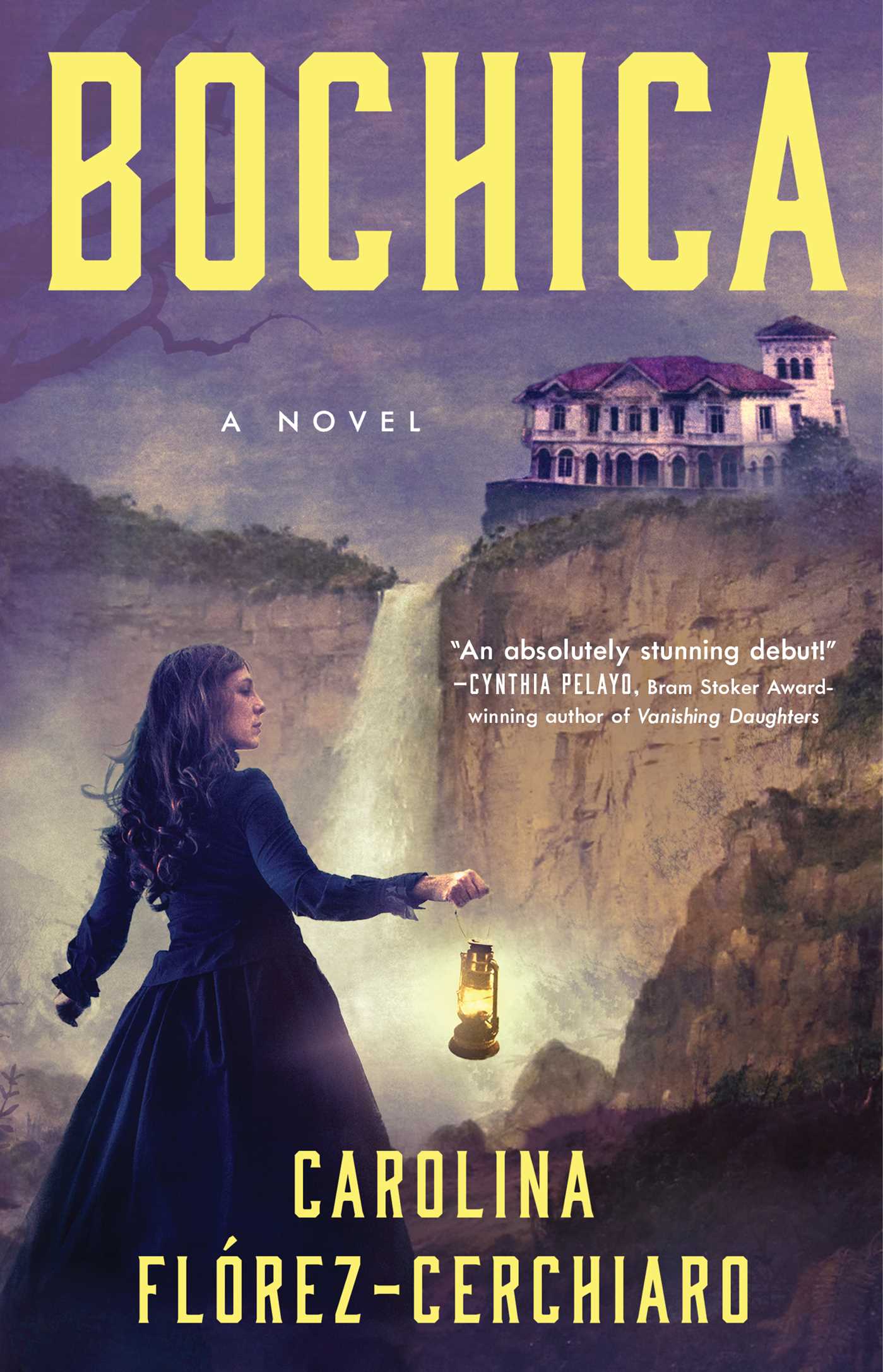
Book Cover Image (jpg): Bochica
Trade Paperback 9781668062586
-
Author Photo (jpg): Carolina Flórez-Cerchiaro Photograph by Juan G. Betancur(0.1 MB)
Any use of an author photo must include its respective photo credit
