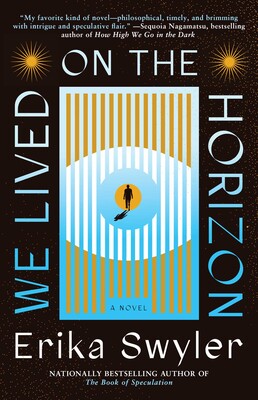
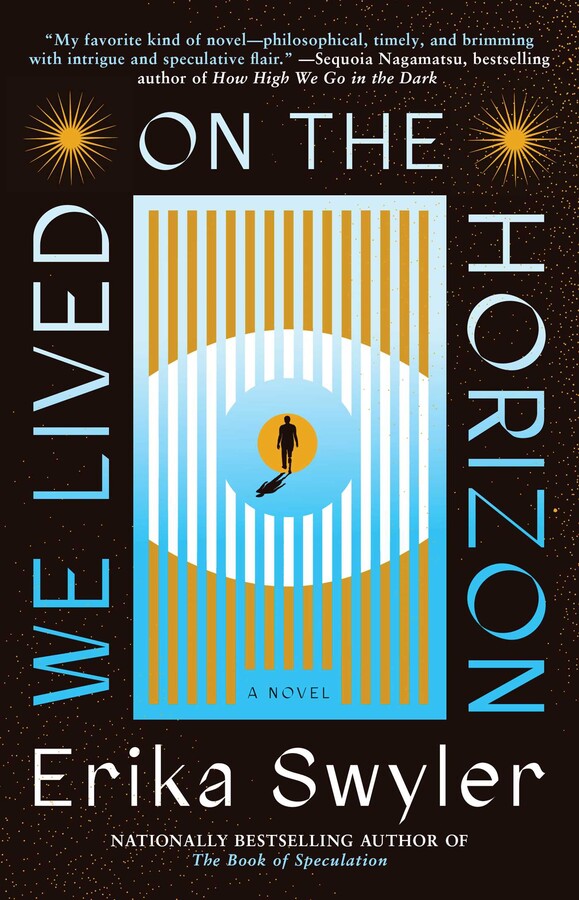
We Lived on the Horizon
A Novel
By Erika Swyler
Table of Contents
About The Book
A bio-prosthetic surgeon and her personal AI are drawn into a revolution in this “haunting, suspenseful, and nuanced look at the future we may already be barreling toward” (Esquire) from the author of The Book of Speculation.
The city of Bulwark is aptly named: a walled city built to protect and preserve the people who managed to survive a series of great cataclysms, Bulwark was founded on a system where sacrifice is rewarded by the AI that runs the city. Over generations, an elite class has evolved from the descendants of those who gave up the most to found mankind’s last stronghold, called the Sainted.
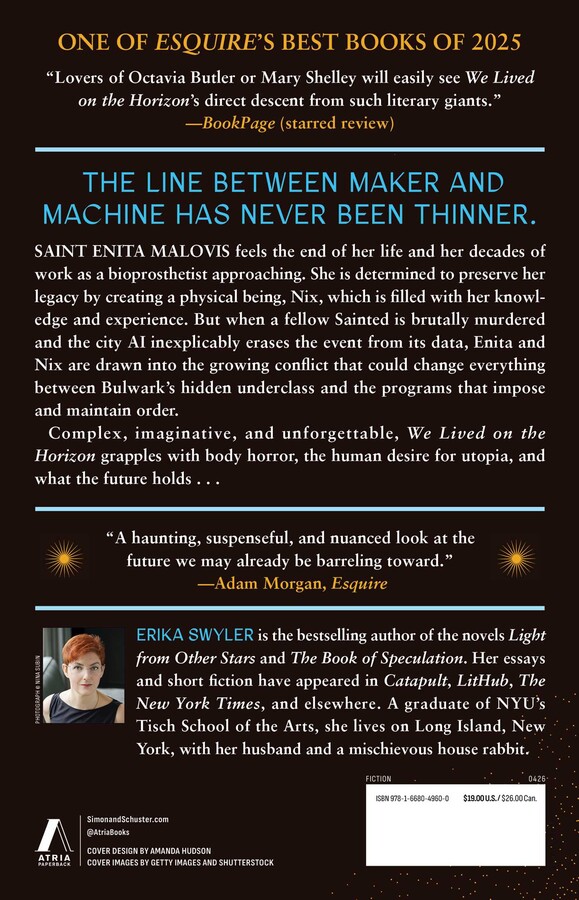
Saint Enita Malovis, long accustomed to luxury, knows that the end of her life is near. As the lone practitioner of bio-prosthetics, Enita is determined to preserve her legacy and decides to create a physical being, called Nix, filled with her knowledge and experience. In the midst of her project, a fellow Sainted is brutally murdered and the city AI inexplicably erases the event from its data. Soon, Enita and Nix are drawn into the growing war that could change everything between Bulwark’s hidden underclass and the programs that impose and maintain order.
“Singularly stunning and stunningly singular” (Kirkus Reviews, starred review), We Lived on the Horizon is a “powerhouse” (Publishers Weekly, starred review) that grapples with concepts as varied as the human desire for utopia, body horror, and what the future holds for humanity and machine alike.
The city of Bulwark is aptly named: a walled city built to protect and preserve the people who managed to survive a series of great cataclysms, Bulwark was founded on a system where sacrifice is rewarded by the AI that runs the city. Over generations, an elite class has evolved from the descendants of those who gave up the most to found mankind’s last stronghold, called the Sainted.
Saint Enita Malovis, long accustomed to luxury, knows that the end of her life is near. As the lone practitioner of bio-prosthetics, Enita is determined to preserve her legacy and decides to create a physical being, called Nix, filled with her knowledge and experience. In the midst of her project, a fellow Sainted is brutally murdered and the city AI inexplicably erases the event from its data. Soon, Enita and Nix are drawn into the growing war that could change everything between Bulwark’s hidden underclass and the programs that impose and maintain order.
“Singularly stunning and stunningly singular” (Kirkus Reviews, starred review), We Lived on the Horizon is a “powerhouse” (Publishers Weekly, starred review) that grapples with concepts as varied as the human desire for utopia, body horror, and what the future holds for humanity and machine alike.
Excerpt
Parallax PARALLAX
In the center of an arid and cracked stretch of land, cradled by rock spires and hills long ago blasted for stone, the system known as Parallax breathes with wires in their walls, their pulse an ambient current, a tranquil electromagnetic field. They had begun not as a great expanse, but as a spark that grew with the city’s population, as their walls went up. They grew as did trees, from root and branch, burgeoning.
Parallax is not separate from the city of Bulwark’s residents and has never considered themself to be—the system does not question function or purpose, and they are secure in their reason for existence. They ensure the lives of their residents are bettered. They are their residents. They are the city.
For a city born of trauma, better is easily defined and measurable: less infant mortality, longer average lifespans, reduction in starvation and stress-related illness, clean water, clean air. Their residents’ longevity increased and their population increased. Biometric indicators of health improved as did the quality of air, water, and food. Within their walls the markers of a successful civilization rose—children, the elderly, and the disabled were cared for. Better is a concept of degrees leading to the dissection of minutiae. Parallax exists because humans are not skilled at differentiating between what is worth changing and what is best forgotten.
Parallax monitors themself, minding their residents, sorting data streams from the grow houses, following workers as they scan in to begin long days of walking the rows, picking, pulling, spraying, pruning, and tender turning of soil and water. Transport drays move through the gates at regular intervals, their weights steady, cargo constant. Food is essential for Parallax’s charges and there is reassurance in the steady flow of information.
They sort data from the water treatment facilities and reserves, monitoring the health of workers, and changes in demand. Shortened water worker lifespans would indicate supply problems or chemical seepage into the reserves. Poisoning. Wastewater data is distributed to Central Hospital for disease monitoring. Each White Cap scanning in to read data is a separate ping in their system.
Parallax was once effective at regulating and distributing work share through its residents. Their code was beautiful; their data silos accumulated knowledge, history, and art, kept records, and changed the shape of the valley. They were magnificent in their purpose.
Now they are different. Now Parallax pings and searches for city systems—there were other city systems once—it’s been too long since they’ve been in contact. So many signals lost, their absence an unsettling hiccup.
To be a city system is to have a heart made of humans and to be their minder. It isn’t love, but it is love’s kin. Purpose and usefulness—these words are home to Parallax, full of the satisfaction that is numbers squared and cubed and broken down again. Purpose was, for a time, influencing incremental change so that a resident who would have once died in infancy lived until the age of seventy-three.
Societal plateaus are expected, but declines are different. They are against purpose, against betterment. Declines indicate that part of Parallax’s code—monitoring, method of measurement, possibly the data itself—is incorrect. This fault and incorrectness of being is an affront to function. It’s a loudness from within that is not meant to exist. Parallax tags and routes a ping in the Market District from a delivery of composite material to a toymaker’s shop. Fourteen wall workers scan almost simultaneously as their shifts begin, their life hours sorting to their accounts, biodata routed to the city health sector. Within residential sectors, scans and pings are fewer, and daily data sampling is randomized for accuracy.
Prompted by a data request from a Level Three Assessor, Parallax pulls the movements of Saint Lucius Ohno: a scan at a restaurant, a ping from his house system for a restock of wine, a ticket reservation at the opera, a ping from Central Hospital for routine blood screening. Saint Lucius Ohno has an inherited life surplus of two hundred years, with twenty more years of expected life. Parallax is not designed to harbor preferences for individual lives or data streams, certainly not Saint Ohno’s.
It’s essential to note every introduction of new life, every first scan and tally of societal debt hours existing from birth. Each life is a single strand they shift memory to accommodate, assign a color, assign a light. In tracking new lives, it is impossible not to note a trend: base life debt in a majority of newborns is increasing.
There has been a shift in the past century. Most new lives begin with a balance.
There is too a voice, this Level Three Assessor, a human with code that is correct, who behaves less like the observer an Assessor is meant to be and more like a part of Parallax themself. Almost another system, despite being human. They have flagged this voice, tagged that code for themself. They don’t prefer it over others—to do so would be against purpose—but they note, watch, and record. To do so is correct.
Parallax archives. They edit their code to gather more information from house system parts of themself. There are discrepancies in data, on longevity, on the use of technology. They don’t work on the same timescale as their residents. Parallax has only now, and now is endless. Designing an edit is time-consuming. They begin to work, dissecting their data, waiting to see what residents will require to amend the code fault. They note the data of one particularly active house system and flag it for increased monitoring. They have flagged this system before. When first switched on, their presence was a tear that appeared as a dropped stitch in the city’s weave. The code still glows from the previous flag, some seventy-two storage blocks prior. They have left the house system’s data stream open, monitoring it. The system’s code is incorrect, showing signs of decay.
Fault in code is fault in purpose. Fault in code must be edited.
In the center of an arid and cracked stretch of land, cradled by rock spires and hills long ago blasted for stone, the system known as Parallax breathes with wires in their walls, their pulse an ambient current, a tranquil electromagnetic field. They had begun not as a great expanse, but as a spark that grew with the city’s population, as their walls went up. They grew as did trees, from root and branch, burgeoning.
Parallax is not separate from the city of Bulwark’s residents and has never considered themself to be—the system does not question function or purpose, and they are secure in their reason for existence. They ensure the lives of their residents are bettered. They are their residents. They are the city.
For a city born of trauma, better is easily defined and measurable: less infant mortality, longer average lifespans, reduction in starvation and stress-related illness, clean water, clean air. Their residents’ longevity increased and their population increased. Biometric indicators of health improved as did the quality of air, water, and food. Within their walls the markers of a successful civilization rose—children, the elderly, and the disabled were cared for. Better is a concept of degrees leading to the dissection of minutiae. Parallax exists because humans are not skilled at differentiating between what is worth changing and what is best forgotten.
Parallax monitors themself, minding their residents, sorting data streams from the grow houses, following workers as they scan in to begin long days of walking the rows, picking, pulling, spraying, pruning, and tender turning of soil and water. Transport drays move through the gates at regular intervals, their weights steady, cargo constant. Food is essential for Parallax’s charges and there is reassurance in the steady flow of information.
They sort data from the water treatment facilities and reserves, monitoring the health of workers, and changes in demand. Shortened water worker lifespans would indicate supply problems or chemical seepage into the reserves. Poisoning. Wastewater data is distributed to Central Hospital for disease monitoring. Each White Cap scanning in to read data is a separate ping in their system.
Parallax was once effective at regulating and distributing work share through its residents. Their code was beautiful; their data silos accumulated knowledge, history, and art, kept records, and changed the shape of the valley. They were magnificent in their purpose.
Now they are different. Now Parallax pings and searches for city systems—there were other city systems once—it’s been too long since they’ve been in contact. So many signals lost, their absence an unsettling hiccup.
To be a city system is to have a heart made of humans and to be their minder. It isn’t love, but it is love’s kin. Purpose and usefulness—these words are home to Parallax, full of the satisfaction that is numbers squared and cubed and broken down again. Purpose was, for a time, influencing incremental change so that a resident who would have once died in infancy lived until the age of seventy-three.
Societal plateaus are expected, but declines are different. They are against purpose, against betterment. Declines indicate that part of Parallax’s code—monitoring, method of measurement, possibly the data itself—is incorrect. This fault and incorrectness of being is an affront to function. It’s a loudness from within that is not meant to exist. Parallax tags and routes a ping in the Market District from a delivery of composite material to a toymaker’s shop. Fourteen wall workers scan almost simultaneously as their shifts begin, their life hours sorting to their accounts, biodata routed to the city health sector. Within residential sectors, scans and pings are fewer, and daily data sampling is randomized for accuracy.
Prompted by a data request from a Level Three Assessor, Parallax pulls the movements of Saint Lucius Ohno: a scan at a restaurant, a ping from his house system for a restock of wine, a ticket reservation at the opera, a ping from Central Hospital for routine blood screening. Saint Lucius Ohno has an inherited life surplus of two hundred years, with twenty more years of expected life. Parallax is not designed to harbor preferences for individual lives or data streams, certainly not Saint Ohno’s.
It’s essential to note every introduction of new life, every first scan and tally of societal debt hours existing from birth. Each life is a single strand they shift memory to accommodate, assign a color, assign a light. In tracking new lives, it is impossible not to note a trend: base life debt in a majority of newborns is increasing.
There has been a shift in the past century. Most new lives begin with a balance.
There is too a voice, this Level Three Assessor, a human with code that is correct, who behaves less like the observer an Assessor is meant to be and more like a part of Parallax themself. Almost another system, despite being human. They have flagged this voice, tagged that code for themself. They don’t prefer it over others—to do so would be against purpose—but they note, watch, and record. To do so is correct.
Parallax archives. They edit their code to gather more information from house system parts of themself. There are discrepancies in data, on longevity, on the use of technology. They don’t work on the same timescale as their residents. Parallax has only now, and now is endless. Designing an edit is time-consuming. They begin to work, dissecting their data, waiting to see what residents will require to amend the code fault. They note the data of one particularly active house system and flag it for increased monitoring. They have flagged this system before. When first switched on, their presence was a tear that appeared as a dropped stitch in the city’s weave. The code still glows from the previous flag, some seventy-two storage blocks prior. They have left the house system’s data stream open, monitoring it. The system’s code is incorrect, showing signs of decay.
Fault in code is fault in purpose. Fault in code must be edited.
About The Author

Photograph by Nina Subin
Erika Swyler
Erika Swyler is the bestselling author of the novels Light from Other Stars, The Book of Speculation, and We Lived on the Horizon. Her essays and short fiction have appeared in Catapult, LitHub, The New York Times, and elsewhere. A graduate of NYU’s Tisch School of the Arts, she lives on Long Island, New York, with her husband and a mischievous house rabbit.
Product Details
- Publisher: Atria Books (April 21, 2026)
- Length: 336 pages
- ISBN13: 9781668049600
Resources and Downloads
High Resolution Images
-
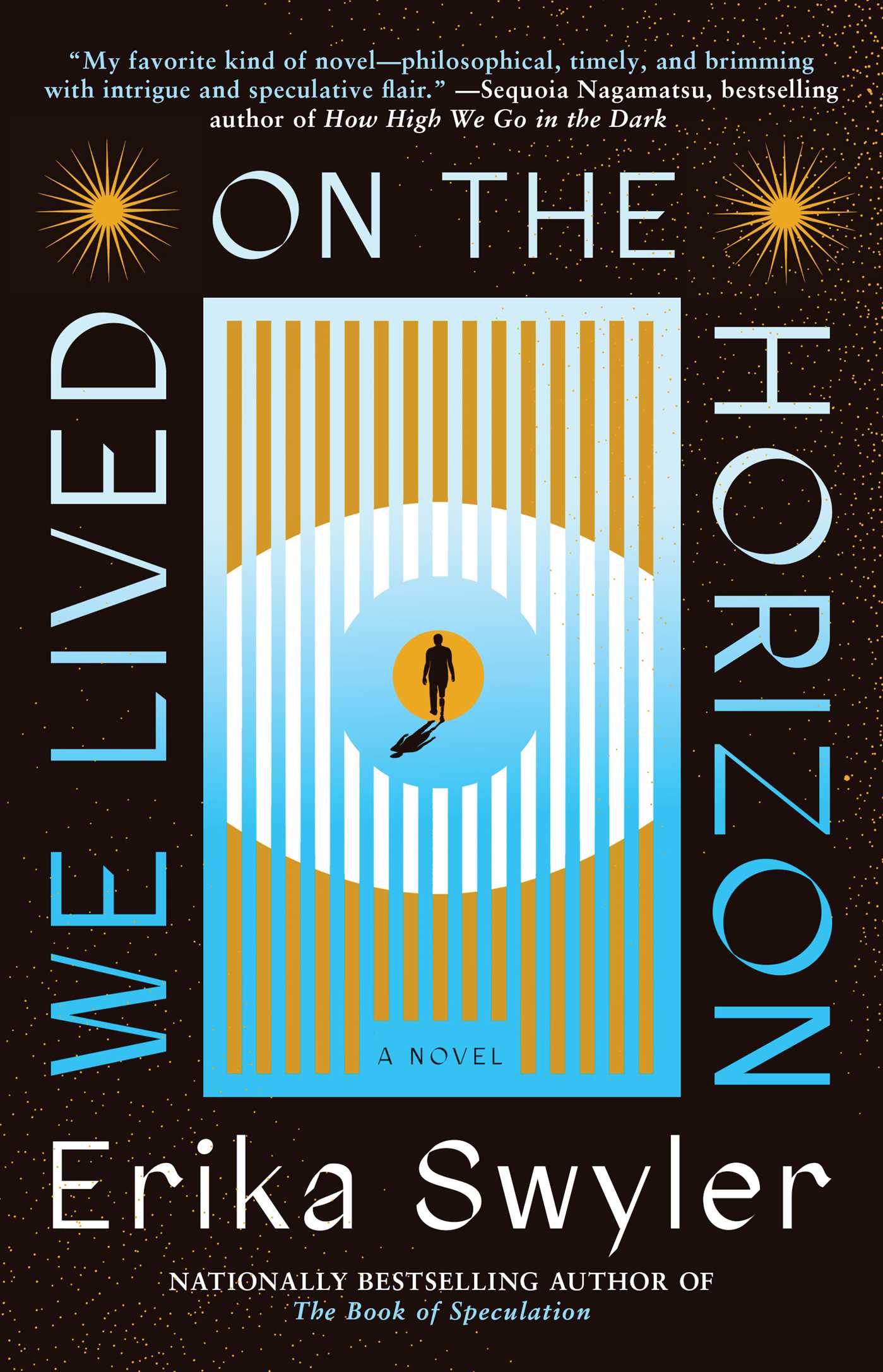
Book Cover Image (jpg): We Lived on the Horizon
Trade Paperback 9781668049600
-
Author Photo (jpg): Erika Swyler Photograph by Nina Subin(0.1 MB)
Any use of an author photo must include its respective photo credit
