
Table of Contents
About The Book
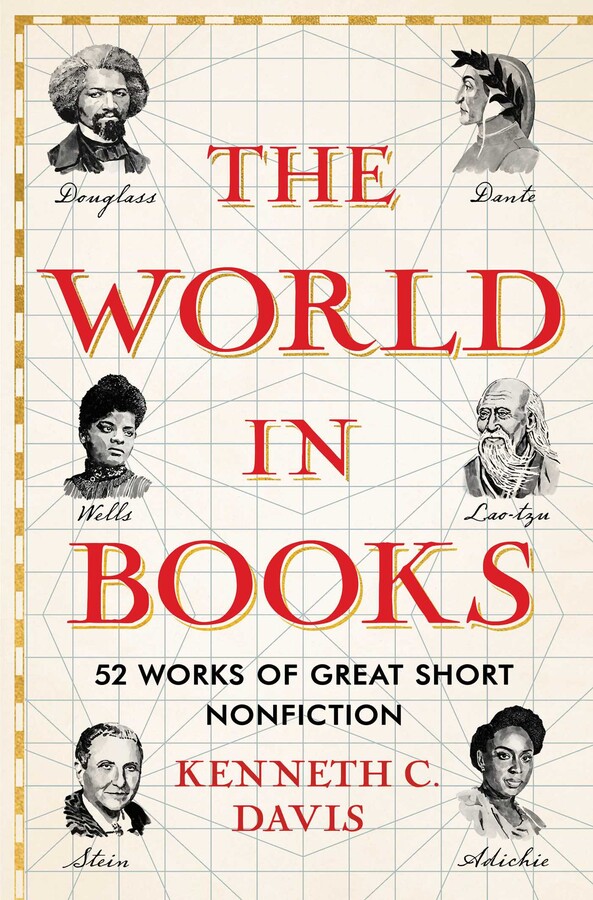
For both avid readers and those looking to spark a new habit, The World in Books is an invitation to a more lively and meaningful intellectual life. Davis’s literary adventure guides readers through some of the most important works of nonfiction of all time, offering a political, literary, and cultural history through reading.
Each of the fifty-two entries provides the book’s opening lines or a brief excerpt from the work; a summary of the work; a biography of the author; why you should read the work; and what to read next. Davis offers insights into some of the most enduring issues of our time—from the existential perspective in Viktor E. Frankl’s Man’s Search for Meaning, to questions of race in Toni Morrison’s The Origin of Others, and the climate crisis in Elizabeth Kolbert’s Under a White Sky. With insights from ancient times to the present day, Kenneth C. Davis offers a wide-ranging historical education through pleasure reading. In an accessible, conversational style, he explores texts that both mirror our contemporary moment and present new ways to think about our lives.
These 52 selections, with books perfect for reading one week at a time, offer a year-long journey through history, philosophy, nature, and personal growth. More than just a literary companion, The World in Books is an education that combines wisdom with practical application. Davis’s work has been called “a wealth of succinct, entertaining advice” (Kirkus Reviews). The World in Books provides an engaging way to explore some of the most influential books ever written. A refresher course for lifelong learners.
Excerpt
“Bitterly Gilgamesh wept for his friend Enkidu”
The Epic of Gilgamesh
— CIRCA 2000 BCE —
Author Unknown
New York: Penguin Books, 1972; translated with an introduction by N. K. Sandars; 128 pages
NOTE: This is a prose version, written at the suggestion of legendary Penguin Books founder Allen Lane and first published in 1960. I used it for its accessibility and readability. But there are numerous verse translations including The Babylonian Gilgamesh Epic, critical ed. and cuneiform texts, translated and edited by Andrew George, London: Oxford University Press, 2003; The Epic of Gilgamesh, 2nd Norton critical ed., translated and edited by Benjamin R. Foster, New York: W. W. Norton, 2019, with extensive notes and essays; and more recently, Gilgamesh: A New Translation of the Ancient Epic, translated from the Akkadian by Sophus Helle, New Haven, CT: Yale University Press, 2021.
OPENING WORDS
I will proclaim to the world the deeds of Gilgamesh. This was the man to whom all things were known; this was the king who knew the countries of the world. He was wise, he saw mysteries and knew secret things, he brought us a tale of the days before the flood. He went on a long journey, was weary, worn-out with labour, returning he rested, he engraved on a stone the whole story.
When the gods created Gilgamesh they gave him a perfect body. Shamash the glorious sun endowed him with beauty, Adad the god of the storm endowed him with courage, the great gods made his beauty perfect, surpassing all others, terrifying like a great wild bull. Two thirds they made him god and one third man.
SUMMARY
We begin at the beginning.
Considered the oldest epic poem in world literature, The Epic of Gilgamesh tells the story of a semidivine king named Gilgamesh, who may have been based on an actual historical figure in one of the world’s first cities, Uruk in ancient Mesopotamia (modern Iraq), but who can also be considered the world’s first superhero. Perfectly formed, possessing superhuman powers and knowledge, larger than life, and with an ego to match, he fits the mold of many other heroes of legend, myth, and literature, such as Hercules, King David of the Bible, or King Arthur of the stories of the Knights of the Round Table.
Ruling over the kingdom of Uruk, Gilgamesh is nearly godlike in his wisdom: he knows all, sees mysteries and secret things; he is unmatched in strength. Despite these gifts, he sets off on a series of adventures, in search of first enlightenment and eventually immortality. Older by far than the Homeric epics and the recorded stories of the Hebrew Old Testament, this tale of his journey takes us through a series of “hero’s quests” that mark this epic poem as a landmark in world literature.
But his arrogance is equal to his wisdom and strength. And he takes women as he chooses. “His lust leaves no virgin to her lover, neither the warrior’s daughter nor the wife of the noble.” To punish his unseemly behavior, the gods create Enkidu, part man, part beast, formed from clay, who lives among the animals. A prototype Frankenstein monster with prodigious sexual endurance, Enkidu leaves the wilderness to challenge Gilgamesh to a fight. Both supernaturally strong, Gilgamesh and Enkidu brawl in the city streets until their match ends in a draw and the pair become friends.
Yes, Gilgamesh is the first “buddy movie”—or perhaps “the first queer love story,” as author and Cambridge University Fellow Robert Macfarlane wrote in the New York Review of Books in 2022, a suggestion that has elicited considerable serious scholarship. Homoeroticism is an ancient theme and comes into play when discussing such heroes as Homer’s Achilles and Patroclus or the Bible’s David and Jonathan, two other pairs of warrior-comrades. These ancient tales remind us that the view of same-sex love in the ancient world was markedly different from that of the condemnation found in Judeo-Christian views, a subject further explored in this collection in Plato’s The Symposium (see entry).
Angry over the failure of their plan to rein in Gilgamesh, the gods send the Bull of Heaven to punish both Enkidu and Gilgamesh. But the pair again confounds the gods. Together, they defeat the bull and dismember it, hurling its thigh—or severed penis, in another translation—at the goddess of fertility and sex, Ishtar. Responding to this new affront, the gods strike Enkidu with a fatal illness. Grieving for his beloved Enkidu, Gilgamesh sets off to find the secret of immortality and encounters the survivor of a great flood—yes, there is a flood story in Gilgamesh that is older than the Noah story in Genesis. Gilgamesh seeks a plant that will allow him to live forever. Will Gilgamesh discover that missing piece that will make him like a god?
ABOUT THE AUTHOR: UNKNOWN
Nothing can be said about the author of these epic poems, which predate Homer and the Bible, because nothing is known. Like the Bible (see Genesis entry), The Epic of Gilgamesh was more likely the work of many authors in the oral tradition before being set down centuries later. “The poem we call Gilgamesh is based on copies of a work assembled over a millennium after the earliest stories were written in Old Babylonian,” explains historian Michael Schmidt. “… A specific scribe, editor, collator, poet is given credit for bringing it all together. He may have also been an exorcist, magician, diviner, priest, or seer; or a combination of these not unrelated vocations…. He is certainly not what we would regard as an author or a poet. His contribution was curatorial.”
So how did the world’s oldest written story come to us? It is an intriguing tale of archeology and human passion. A set of fragmented clay tablets, inscribed in cuneiform, one of the earliest known forms of writing, was discovered in the ruins of a temple in Nineveh, capital of the ancient Assyrian Empire, and brought to London in the mid-nineteenth century. There these shards of ancient writing remained until George Smith, a young printer, studied the tablets in the British Museum on his lunch break and cracked the code of the language inscribed on them. He was eventually given a position in the museum. Smith created the first English translation of one of the fragmented tablets of Gilgamesh and, in 1873, he published an article titled “The Chaldean Account of the Deluge,” an episode from Gilgamesh trumpeting a story of a great flood that mirrored the flood account in Genesis.
Smith’s revelation about the existence of a flood account that predated the story of Noah and his ark made international headlines. Newspapers began to sponsor expeditions to find further pieces of the story. Smith himself was sent by the British Museum to excavate an Assyrian site and died of dysentery in August 1876 during that trip. Since Smith’s first translation, many other fragments of Gilgamesh have turned up and multiple translations now exist of what is considered the world’s oldest story.
WHY YOU SHOULD READ IT
I’ll be honest here. My Akkadian isn’t great.
So, why read this ancient text when we don’t really know why—or for whom—it was written? I first encountered Gilgamesh in writing my earlier books about the Bible and mythology, for the simple reason that, like many before me, I was fascinated by the idea that there was another flood account from the ancient Middle East. Raised on the story of Noah’s ark from childhood Sunday school lessons, I experienced one of those “Why didn’t they tell us that?” moments.
Gilgamesh explores themes that have driven storytelling from its very beginnings to modern times. It is an essential hero’s quest: a series of adventures and trials aimed at gaining knowledge and power; in the case of Gilgamesh, he seeks the ultimate power of immortality. This is a reflection of the powerful desire of humans to be like gods, prevalent throughout mythology. It is also a story about friendship and loss. It is a story of the quest for meaning. In a recent version, translator Sophus Helle writes: “One reason for the epic’s appeal is that it lures the reader in with a mix of wild energy and sober reflection. Gilgamesh the hero is youthful and rash, but Gilgamesh the epic is much more melancholic, full of meditations on death and the burden of community.”
For these reasons, this ancient work—still being investigated and retranslated as new fragments turn up—remains such a subject of deep fascination. A 2003 edition of Gilgamesh is based on more than 180 fragments. And as recently as 2015, an Iraqi museum reported the discovery of twenty missing lines of poetry. In other words, there may be more Gilgamesh yet to be discovered. As new discoveries open up ancient mysteries, we must continue to explore the connections between myths and folklore that have influenced the sacred stories people have told for thousands of years. Storytelling is one key to what makes humans different from other creatures, and there are many stories, like this, that people have told for longer than we know.
Including Gilgamesh in this book represents the first case of an arbitrary bending of my rules. Like the Bhagavad Gita and other epic poems across the ancient world, Gilgamesh is essentially a work of fiction. But as with other legends, myths, fables, and fairy tales told by people across human time, it is fiction that gets at truth. Myths, after all, are not simply “make-believe.” They have always been a culture’s sacred stories, meant to convey a vision of truth. And like much of the greatest literature, it speaks to us over the centuries.
“Why does Gilgamesh continue to concern us? One reason is the durability of its central preoccupations,” Robert Macfarlane wrote. “Ecocide, poor governance, toxic masculinity, fear of death, invasion, insomnia: Gilgamesh’s themes could be transcribed from yesterday’s newspaper.”
WHAT TO READ NEXT
There is no sequel. Sorry. If Gilgamesh intrigues you, I would suggest an excellent—but short—deep dive into the history of the work and its many translations over time, Gilgamesh: The Life of a Poem. Michael Schmidt’s work, cited earlier, offers a fascinating history of how the poem came to be and how it has been viewed over history and continues to be revitalized today.
To explore further the mythology and literature of ancient Mesopotamia, the so-called Cradle of Civilization, I suggest Inana: Queen of Heaven and Earth, by Diane Wolkstein, and Inana: Lady of Largest Heart, by Betty De Shong Meador, which explore the goddess Ishtar. Some of the poems about this goddess are attributed to a priestess named Enheduanna, credited as the first named author in history. She Who Wrote: Enheduanna and Women of Mesopotamia ca. 3400–2000 tells her story and provides a rich visual introduction to the society from which Gilgamesh emerged. Another way to explore these ancient stories is through the work of Joseph Campbell in such books as The Power of Myth or The Hero with a Thousand Faces, or through Harvard professor Maria Tatar’s 2021 book, The Heroine with 1001 Faces, which deals specifically with the traditional absence of women in male-centric hero quests and the important history of “heroinism.”
About The Author

Kenneth C. Davis has lived a life in books. He is the New York Times bestselling author of America’s Hidden History and Don’t Know Much About History, which gave rise to his series of books and audiobooks on a range of subjects, including mythology, the Bible, geography, and the Civil War. Davis’s work has appeared in The New York Times, The Washington Post, and Smithsonian magazine, among other publications. He has appeared on national television and radio shows, including CBS Mornings, Today, and NPR. He lives in the West Village of New York City with his wife, Joann Davis.
Product Details
- Publisher: Scribner (October 8, 2024)
- Length: 464 pages
- ISBN13: 9781668015599
Raves and Reviews
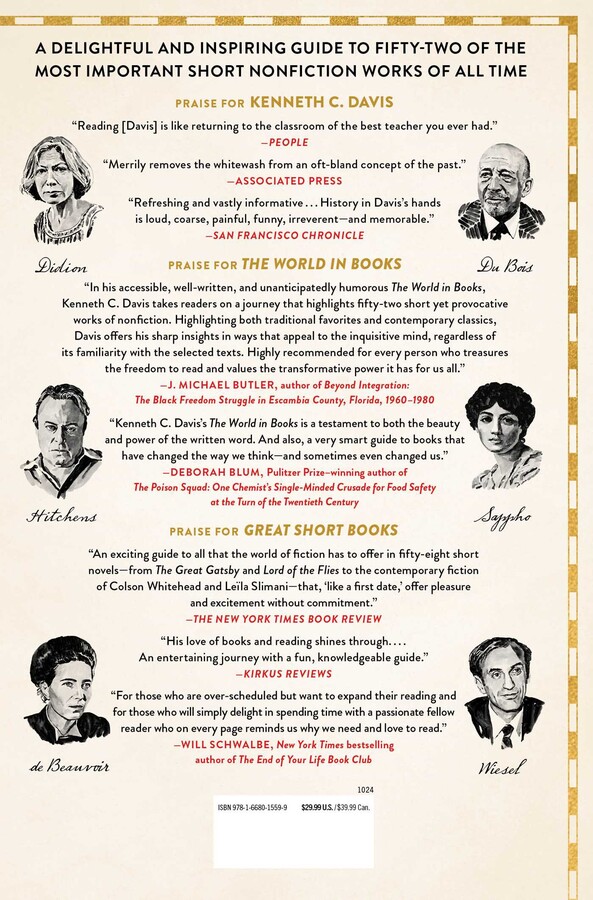
"A guide to 52 of the most influential works of nonfiction ever published, spanning works from Plato to Ida B. Wells, bell hooks to Barbara Ehrenreich, and Sun Tzu to Joan Didion...[for] lovers of nonfiction looking to cover their canonical bases."
—The Millions
"An appetizing new book [that] offers up a list of 52 of the best short nonfiction books in history…The World in Books entices you with descriptions of some of the best (short) nonfiction in history and why they’re so important."
—Parade
“In an age of screens, AI, and shrinking attention spans, a good book is more important and valuable than ever… A wealth of succinct, entertaining advice.”
—Kirkus Reviews
“In his accessible, well-written, and unanticipatedly humorous The World in Books, Kenneth C. Davis takes readers on a journey that highlights fifty-two short yet provocative works of non-fiction. Highlighting both traditional favorites and contemporary classics, Davis offers his sharp insights in ways that appeal to the inquisitive mind, regardless of its familiarity with the selected texts. His poignant 'Introduction' sets the stage for the contemporary relevance of why books like these matter in contemporary times, which makes this collection all the more relevant. Highly recommended for every person who treasures the freedom to read and values the transformative power it has for us all.”
—J. Michael Butler, author of Beyond Integration: The Black Freedom Struggle in Escambia County, Florida, 1960-1980
“Kenneth C. Davis’s The World in Books is a testament to both the beauty and power of the written word. And also, a very smart guide to books that have changed the way we think—and sometimes even changed us.”
—Deborah Blum, Pulitzer-Prize winning author of The Poison Squad: One Chemist's Single-Minded Crusade for Food Safety at the Turn of the Twentieth Century
Resources and Downloads
High Resolution Images
-
Book Cover Image (jpg): The World in Books
Hardcover 9781668015599
-
Author Photo (jpg): Kenneth C. Davis Photo credit: © Nina Subin(0.1 MB)
Any use of an author photo must include its respective photo credit


