
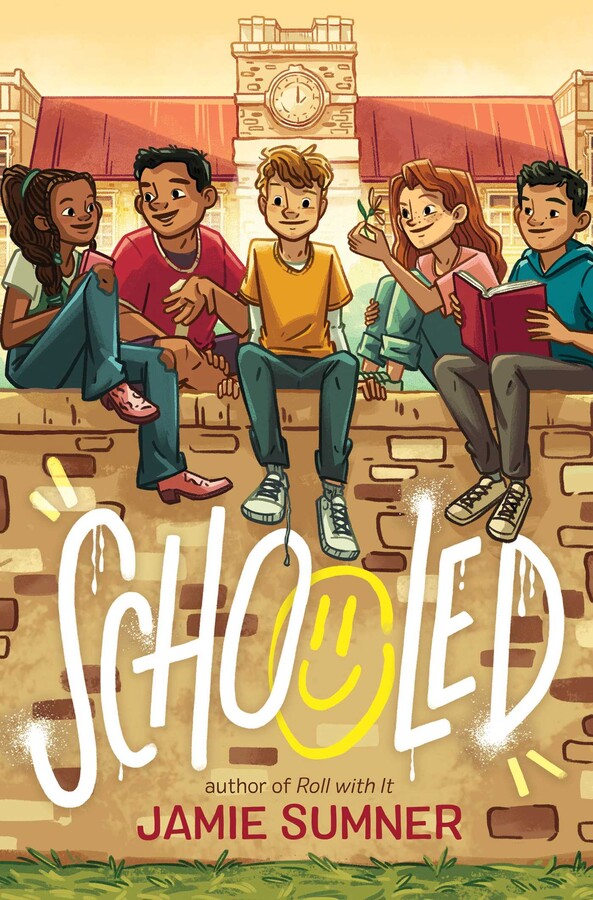
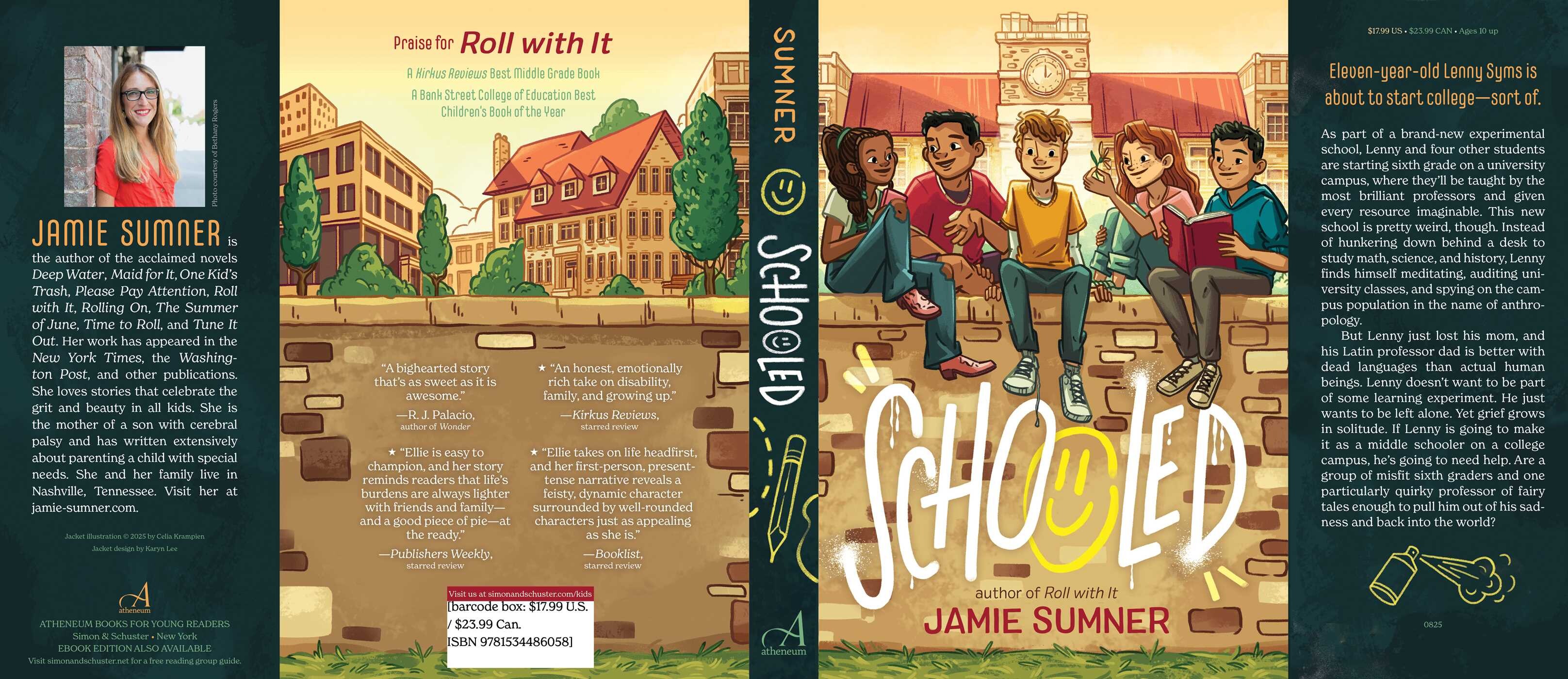
Schooled
Table of Contents
About The Book
An “insightful and absorbing” (Shelf Awareness, starred review) novel from acclaimed author Jamie Sumner about new schools, unexpected friendships, and overcoming loss.
Eleven-year-old Lenny Syms is about to start college—sort of. As part of a brand-new experimental school, Lenny and four other students are starting sixth grade on a university campus, where they’ll be taught by the most brilliant professors and given every resource imaginable.
This new school is pretty weird, though. Instead of hunkering down behind a desk to study math, science, and history, Lenny finds himself meditating, participating in discussions where you don’t even have to raise your hand, and spying on the campus population in the name of anthropology.
But Lenny just lost his mom, and his Latin professor dad is better with dead languages than actual human beings. Lenny doesn’t want to be part of some learning experiment. He just wants to be left alone. Yet if Lenny is going to make it as a middle schooler on a college campus, he’s going to need help. Is a group of misfit sixth graders and one particularly quirky professor enough to pull him out of his sadness and back into the world?
Excerpt
I slouch down as far as I can in my seat. I am practicing invisibility. There’s nothing of me to see above the dash except maybe one fluffed-up bit of yellow hair. So far so good. I hold my phone camera up to watch the happenings outside the van like a spy. Twentysomethings are manhandling couches and floor lamps and… is that a fire pit? Wouldn’t surprise me. The married-student dorm is a lawless place on move-in day.
I drop the phone in my lap, slink down farther in my seat, and try not to let the ache in my throat sneak out in a sound. I swallow down the sadness like a pill with no water. This is not how sixth grade is supposed to go. For many reasons. Moving onto a university campus is just one of them.
“Where do they keep the babies when everyone’s in school? In the basement next to the dumpsters?” I ask Dad, who is staring up at the street sign to see if he’s allowed to park our beast of a van here.
“I think,” Dad says, forgetting the street sign and following the path of the fire pit with squinched eyes, “the university provides child care somewhere near the student center.”
“Benji,” I say from the subterranean depths of my seat, “you never could take a joke.”
His laugh is the sound of air whooshing out of a tire. Mom was the only one who ever called him Benji. With his cardigans and creased khakis, Professor Benjamin Syms isn’t the Benji type, at least not to anyone but her. Mom would tell me not to poke with my words. I should say I’m sorry. But in a weird way, I’d rather feel bad about this than sad about Mom.
I pick my phone back up and zoom in on a smiley face graffitied next to the stairwell of the tall, bland building. I let my eyes rise up and up to what I think is the seventh floor of Lewis Hall, my new home at Arrington University. I’m using the term “home” loosely here.
It could be worse, I think as Dad pops open all the sliding doors of the van and a rug flops out onto the curb. It’s the green rag rug that Mom wove for the kitchen in the house in New Jersey I’ll never see again. My stomach plops right down next to it on the curb. No, I decide, this is as bad as it gets.
Dad grunts as he picks up two large duffel bags. “Help me with the suitcases, will you?” I eye him in the side mirror, with his belted shorts and Reeboks and VENI VIDI VICI T-shirt. He’s a super-geek Latin professor, but why does he have to advertise it?
With a sigh, I open the door and grab one single plastic shopping bag filled with power cords and chargers, because give me internet or give me death. While Dad’s back is turned, I also scoop up the rug and gently roll it up again. Then, with a deep, deep breath, I follow him toward the glass front doors.
The elevator takes approximately five hours to ding from five to four to three to two while we wait for it in the lobby. Then the “marrieds” come spilling out. That’s what I’ve decided to call them, the couples in our building with their Crock-Pots and dish towels and Old Navy flip-flops slapping down the sidewalks. They barely break stride to veer around us as they march in and out and in and out with their boxes jam-packed with stuff. Dad and I are two rocks in a river—sunk and stuck—while everyone else sails by. We could have lived off campus, gotten a tiny little house with a busted fence and funky-smelling closets. I wouldn’t have complained. But no, Dad wanted “community” and “inclusivity” and some other “ity” word that was just another excuse for the two of us to be alone together as little as possible. All his students love him. He’s great at small talk, as long as it’s not with me.
Dad looks uncomfortable in the elevator. He’s not good in enclosed spaces, and here we are inhaling the same fuggy air as six other humans, two rabbits, and a potted plant. It’s entertaining, watching him try to breathe in and out only through his mouth. I keep my eyes on him so I don’t have to look at anybody else. I’m an eleven-year-old in a dorm. I don’t know who’s more out of place—me or the rabbits.
The doors open on floor five and the rabbits and their owner exit. This will be how it is now, I think. I will be that kid who never fits in anywhere. I grip Mom’s rug. If she were here, she’d know what to say. Actually, if she were here, we wouldn’t be in this stuffy elevator in the first place. I close my eyes and picture her toward the end, when her jet-black hair was so short, it looked like she’d buzzed it. Except it was the other way around, just growing back in. She’s laughing and waving around a vinyl record at that place on West Fourth where the owner gave her a secret discount because she went so often. “Smile, Lenny, let the music move through you!” she singsongs, and pulls me dancing down the aisle.
The elevator dings, and I open my eyes and blink and blink until the tears shrink back. Smile, Lenny! This is our floor. Lucky number seven.
“You first, buddy,” Dad says.
“Buddy” is a new word he’s trying out, along with “pal” and “kiddo” and, once, “sweetie.” It’s like we lost our interpreter now that Mom’s gone. We have to invent a whole new language.
I step out into the hallway under a fluorescent light that flickers and makes the skin on my arms look yellow. The carpet is a dirty orange, and the whole place smells like a McDonald’s PlayPlace—french fries and feet. Our house in New Jersey had wood floors that creaked and a tiny fireplace that smoked us out at least once every winter. I miss it so much it makes my teeth ache.
“Seven-oh-one,” Dad mutters to himself over and over again, looking from his key to the gold numbers on the doors as we shuffle down the hallway. All the way at the end I spot our door, which someone appears to be… setting on fire?
“Um, can we help you?” Dad asks the fire starter, who, when we get up close, turns out to be a girl roughly my age. She’s the only other kid I’ve seen since we got here. I immediately get nervous and then shift the bag of power cords from one hand to the other in case she waves and I need to wave back. But she ignores us. So much for community. We watch for a few more seconds as she continues to wave a smoky stick up and down and across the door. The elevator dings again in the distance.
“Ahem,” Dad says, a bit louder.
After one last up-down swipe, the girl spits on the end of her stick so that it sizzles out, and turns.
“Hi!” she says, holding out a hand, which forces Dad to put down a duffel and shake. “I’m Hen. I live on the second floor. I was just smudging your door. A sage cleansing to start the year. Don’t call me Henrietta,” she says to me, like I had any intention of speaking whatsoever.
“Hen, yes! You must be Don’s girl.” Dad is grinning now, happy to have found the method to this madness. “Lenny, this is Hen. She’ll be one of the other students in your class.”
“Hi,” I mumble, and forget to wave with my freed-up hand.
“Hi back,” she says.
I study Hen from underneath the swoop of hair I spent all of fifth grade perfecting. She is all elbows and knees and impossibly long red hair that seems to move all on its own. If she were a tree, she’d be a weeping willow. She’s wearing rainbow leggings and she’s smiling, but her eyes say don’t mess with me.
When Dad finally manages to fumble the key into the lock and creak open the door, Hen follows us in, without waiting to be invited, to complete her “cleansing” or whatever it is inside the apartment. Apparently, she tried to pick the locks with a bobby pin but had no luck.
“Otherwise, I would have been long gone by now,” she adds before stepping back out into the hallway. “The cleansing works better if you have time to let it spread on its own before you muddy it up with your auras.”
“Uh, right,” I say as Dad squeezes past us toward the elevator to get another round of stuff.
“You’re Lenny,” she states, and because it’s not really a question, I stand there with my hands in my pockets.
She tucks her sage sticks into her messenger bag and looks me up and down. I lean against the doorframe, trying to look both bored and cool, which is really hard to do when someone is staring at you like they can see into your soul.
“Well, Lenny, welcome to the Copernican School,” she says before swishing her long hair over her shoulder. “It should be… an interesting experiment.” And then Hen leaves, banging open the metal door next to our apartment and taking the stairs two at a time.
Reading Group Guide
Schooled
By Jamie Sumner
Discussion Questions
1. Why do Lenny and his dad move to Arrington University? Do you think moving is a good way to reset after experiencing something difficult in your life? How does moving change Lenny’s and his dad’s lives?
2. Why do you think it’s so hard for Lenny and his dad to talk to each other? Have you ever felt like it’s hard to talk to your parents or other adults in your life? Why? Do you think they ever find it hard to talk to you?
3. What was Lenny’s mom like? What does Lenny miss most about her? How does Lenny’s family function without her in it?
4. Why do you think Lenny is so resistant to becoming friends with Hen? How does their relationship change over the course of the book?
5. How does belonging or not belonging shape the way Lenny sees himself? Have you ever felt like you didn’t belong at your school or somewhere else? How did it make you feel? Did you eventually find a sense of belonging? How?
6. Why do you think Lenny is so resistant to the Copernican School? Why would you want to attend a school like this? Do you prefer learning through experiences, or do you like a more traditional classroom?
7. Lenny’s teacher Paulo tells them that “‘Happiness comes when you realize it’s not about you.’” (Chapter two) What do you think he means by this? Do you agree? Do you think Lenny agrees with this sentiment by the end of the story?
8. What role do Lenny’s new classmates play in his journey over the course of the book? How do they help him? How does Lenny help them? Were you surprised by how their relationships changed?
9. Lenny wonders how the teachers at his school “can ask such big stuff from us.” (Chapter fifteen) Do you ever feel like teachers or other adults in your life are asking you to do things that are more difficult than you feel ready for? How do you respond when that happens? How do the adults in your life support you when they ask you to do big things?
10. One of Lenny’s teachers has the kids take a personality test that categorizes each student as a Questioner, Rebel, Obliger, or Upholder. Which one is Lenny? Which one do you think you are? Do you think personality tests like this are useful? Explain your answer.
11. In one of his lectures, VW says, “‘Fairy tales and mythology exist to reveal the basic truths in all of human nature.’” (Chapter eleven) What does he mean by this? What is your favorite fairy tale or myth? What meaning do you see in it? What do we, as humans, gain from sharing and reading stories?
12. Why does Lenny decide not to participate in the assignments for the Copernican School? Do you think this is a wise decision? Why does he make an exception for VW’s class?
13. Why do you think the professor, VW, befriends Lenny? What do the two have in common? What do they bring into each other’s lives?
14. Why do you think Lenny’s dad puts all of Lenny’s mom’s stuff in storage? How does that make Lenny feel?
15. Why does Lenny start spending time in the storage locker with his mom’s stuff? Why doesn’t he tell his dad? What does his dad do when he finds out? What did you think about his dad’s reaction?
16. Have you ever felt like Lenny, stuck in a new situation you didn’t choose? How did you handle it? What advice would you give to Lenny?
17. Have you ever lost someone close to you? What did that experience feel like? What helps you cope with your grief?
18. After they become friends, Lenny says, “This is what I love about Hen. She doesn’t care if something seems weird or doesn’t make sense right away. She just settles into it.” (Chapter thirteen) Why is this behavior appealing to Lenny?
19. Lenny says, “It’s like I lost both my parents when Mom died.” (Chapter nine) Why does he feel like this? Have you ever watched your parents or another adult you know struggle with something really difficult? How did it make you feel?
20. How does Lenny’s relationship with his dad change over the course of the book? Were you surprised by where they ended up? Explain your answer.
21. Lenny is especially moved by listening to one of his mom’s favorite songs, Leonard Cohen’s “Hallelujah.” Listen to this song. How does it make you feel? Why do you think it might be meaningful to Lenny at this stage of his life?
22. How does Lenny’s dad react when he finds out about Lenny’s grief comic book project? Explain why you do or don’t think this is a fair reaction. How does it make Lenny feel?
23. Toward the end of the book, Lenny dreams of his mom. What happens in his dream? How does it make Lenny feel? Have you ever had a dream that changed how you felt about the world?
24. What does Lenny decide to do when the university is threatening to fire VW? Do you think this is a good decision? Why do you think the other Copernican kids decide to help Lenny? What are the consequences of their actions?
Extension Activities
1. My Ideal School. Create a presentation about your ideal school. It can be a poster, book, slideshow, or another medium of your choice. What would students at your school study? Where would classes be held? What would a day of school look like? If you’d like, you can draw a map of the school, illustrate what a classroom would look like, or build a model of your perfect classroom.
2. Coping Through Comics. Lenny’s capstone project for the Copernican School is a comic book that helps kids cope with grief. Spend some time studying comic books and/or graphic novels. What do you notice about how they tell stories? Lenny says about the white space in comic books, that “it’s the reader’s job to fill in the gaps of the blank spaces in a comic. The white breaks are where all the action happens.” (Chapter fourteen) How do the comic books you find use white space? After your exploration, create your own comic book or graphic novel to help kids your age through a difficult experience or big feelings.
3. Write a Modern Fairy Tale. Write your own modern fairy tale that reveals a truth about human nature in today’s world. Begin by reading a few familiar fairy tales, such as “Little Red Riding Hood,” “Jack and the Beanstalk,” the Anansi stories, the Arabian Nights, etc. What lessons or human truths do these stories teach? For example, kindness is rewarded, or bravery comes in many forms. Now think about a truth of human nature that matters to you and your friends. Write your own fairy tale to reveal this truth. Be sure to include a magical or unusual element, characters who face a challenge, and a theme or lesson that reflects a truth about human nature.
4. Create a Memory Box. One of the ways that Lenny copes with grief over his mother is by spending time with her belongings in the storage locker. Create a memory box that helps you feel close to someone important in your life, whether they are still living or have passed away. Fill it with small objects, drawings, quotes, and other things that remind you of the person.
5. Create a Playlist. Lenny spends a lot of time playing his mom’s records and reliving the memories the music brings back about his time with his mom. Make a playlist of songs that remind you of one or more of your loved ones. Why did you choose each song? What person or memory is attached to each song?
6. Letters to Lenny. Imagine you are Lenny. Write a letter to an old friend back home in New York, telling them about your new life and its challenges. Then imagine you are the friend and write a letter back to Lenny giving him advice about how to handle these challenges.
Chris Clark is a writer and reading teacher who lives with her family in coastal Maine.
This guide has been provided by Simon & Schuster for classroom, library, and reading group use. It may be reproduced in its entirety or excerpted for these purposes. For more Simon & Schuster guides and classroom materials, please visit simonandschuster.net/m/prek12-teachers-librarians/teaching-resources.
About The Author

Jamie Sumner is the author of the Roll with It trilogy, Tune It Out, One Kid’s Trash, The Summer of June, Maid for It, Deep Water, Please Pay Attention, Schooled, Glory Be, and Wish You Well. Her work has appeared in The New York Times, The Washington Post, and other publications. She loves stories that celebrate the grit and beauty in all kids. She is also the mother of a son with cerebral palsy and has written extensively about parenting a child with special needs. She and her family live in Nashville, Tennessee. Visit her at Jamie-Sumner.com.
Product Details
- Publisher: Atheneum Books for Young Readers (August 26, 2025)
- Length: 224 pages
- ISBN13: 9781534486058
- Ages: 10 - 99
Raves and Reviews
* “[A]n insightful and absorbing coming-of-age middle-grade novel . . . a fascinating exploration of education, sorrow, and the tensions of adolescence . . . Sumner brilliantly imagines a caring alternate educational path yet highlights the universal nature of insecurity and stress; Schooled is a heartfelt reminder that growing up can be painful but, luckily, it doesn't have to be done alone.”
– Shelf Awareness, STARRED REVIEW
“A quirky exploration of grief and the unexpected ways kids work through life’s challenges. . . . a unique take on loss, friendship, and self-discovery. This story of Lenny's unconventional life will hold highest appeal for tweens who enjoy unique, heartfelt narratives.”
– School Library Journal
“A witty voice, endearingly eccentric ragtag group of characters, and silly high jinks combine with philosophical musings as these lovable folks, each with their own battles and stories, come together to build a new community together.”
– Booklist
"Sumner skillfully depicts standard coming-of-age themes like finding community and navigating grief with fresh humor and vitality."
– Publishers Weekly
"Quirky characters navigate life’s ups and downs."
– Kirkus Reviews
Awards and Honors
- Golden Kite Award Honor
Resources and Downloads
High Resolution Images
-
Book Cover Image (jpg): Schooled
Hardcover 9781534486058

-
Author Photo (jpg): Jamie Sumner Photograph by Bethany Rogers(0.1 MB)
Any use of an author photo must include its respective photo credit
